5 Ways to Comfort a Hurting Friend During the Holidays

Welcome December! Welcome festive holiday cheer, brilliant lights, fanciful presents strung up with ribbons and bows. Welcome mittens, toboggans, and snow… please come snow. Welcome singing, joy, and toasty mugs held close to the lips with both hands. Welcome stockings, trees, and porcelain finery preserved for generations and proudly displayed for one month before being packed back up. Welcome friends, family, and warm feelings for all humankind. Welcome tears…

Wait, what? Tears?

Yes, Tears. All of the aforementioned pleasures that warm most of us can cause angst, dread, and tears for those who are hurting. Unfortunately, in our childhood cancer world, too many are forced to face this season without the children who make it so special. But we don’t have the market cornered on pain. Many are dealing with heartbreak and struggles. While December is a season of love and giving, it also seems to magnify pain and loss. Maybe that loss is a child, a spouse, a parent, or a relationship that they thought was forever. If we pull back the smiles like an old winter coat, we all have friends who are hurting.

So what can you do during December to comfort your hurting friend?

Of course, there is no pat answer for every situation. No two hurt alike and no two respond to the holidays in the same way. But as a father facing his second December without his daughter, I want to offer five tips that may help.

1 Invite but don’t expect – We hurting run a fine line. We don’t want to be left out of every social occasion, but the thought of being amongst revelers at a holiday party can feel completely overwhelming. So while you might get turned down, please send the invitation. If they accept, set the place but also know that the grief ride is full of sudden twists and turns that might make your friend back out at the last minute. If that happens, the last thing they need is a guilt trip – their ride is wild enough.

Another note is that my wife and I have turned down invitations simply because we don’t wish to bring a somber tone to a party. That may seem ridiculous, but we have seen the tenor of room change when we enter because friends are either concerned about our emotional state or worried that others will say or do something that will upset us.

2. Offer tangible help – Maybe you can’t buy an expensive gift, but can you hang outdoor lights? Can you afford a couple of hours to help decorate a tree that otherwise wouldn’t make it out of the box? Could you spend an afternoon wrapping presents? Could you offer shopping advice to a man who has lost his wife to help minimize a letdown for their children? This is the action side of love. Love does! Love molds unique talents into lavish gifts. Doing love doesn’t have to be grandiose or expensive and is often best when anonymous.

3. Speak their name – There is a common theme among my fellow grievers: we all live in constant fear that our loved ones will be forgotten. After the shock of the loss recedes, this is the next frightening and painful thought that keeps us up at night. The holidays magnify this fear. You can help by simply speaking their name. Do you remember a funny story about a holiday gone by or did you find a picture that made you smile? Share it. Send a note with a special memory. You could even look for an ornament that reminds you of your friend’s loved one. Did they love penguins, princesses, or tools? An ornament would be a special touch that tells your friend that you remember.

4. Respect a decision to minimize – The holidays tend to turn our hearts toward home. Regardless of how much a grieving person enjoyed holidays past, there will be moments that are deeply and profoundly painful because that home is no longer intact. Every decoration and light brings the loss to mind. So please understand that a person who is grieving may identify with Ebenezer Scrooge, The Grinch, and Burgermeister Meisterburger much more than Bob Cratchett, the Who’s in Whoville, or Kris Kringle. They may not decorate at all and shun celebration – and that’s okay!

5. Give of yourself – Everyone likes shiny presents. But we who are hurting need your time more than anything you could wrap. It might be rebuffed, but a genuine offer of presence is more valuable than gold. Knowing that someone is available should the need arise could very well be the thing that gets your friend through the season. If called upon, come loaded with tissues and a tender shoulder – say little and listen much and know that you’ve given the best gift.

I can’t know your friend’s situation, but the overarching theme here is love and communication. Your friend is wounded by loss and the holidays often feel like coarse salt rubbed into the wound by a big, fat mitten. Tread cautiously, lovingly, and be there to share the happiest holidays possible.
Your Piece of the Puzzle

Your Piece of the Puzzle


Have you ever sat over a puzzle for endless hours searching for the last edge piece? It might be a color and pattern that should be easy to find and yet, among all of the others that look so similar, it can elude even the most relentless pursuit.

Sometimes the answer to a problem in real life can be just as elusive. Even when your soul yearns to help, the way to do so can be hard to find. Just ask Melissa. A few years ago, Melissa heard about a boy named Lake at her church who was fighting cancer for the second time. A mother herself, she felt an immediate connection with Lake’s mother who was about to have another child. Her heart went out to this family who were thrust back into a fight for his life and she felt compelled to do something. But she had no idea what piece she could play in this puzzle since she didn’t know the family personally.

Some people stop there. With the noblest of intentions, they scour the table, decide there is no way to find their piece and then put the puzzle in the box. They still feel bad and hope that someone will help, but they don’t continue to search for a way.

Not Melissa. She knew she had to do something. When Lake passed away in May of 2015, she was devastated. But that event cemented her calling to do something in his memory.

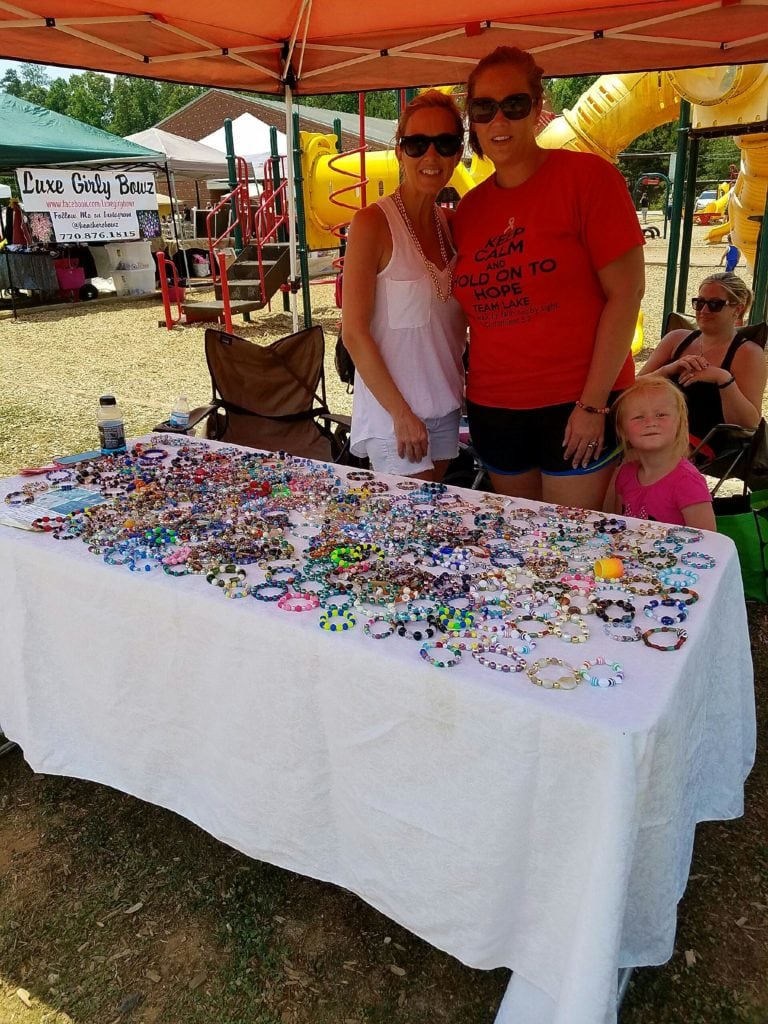
So she decided to raise money for CURE Childhood Cancer. The question of how she would go about doing that plagued her. As she considered the question, an idea of making and selling beaded bracelets began forming in her mind. This lead to even more questions because jewelry-making wasn’t something she had any experience with. But she took the plunge and decided to take up a new hobby with the hopes of honoring Lake and his family.

In August, she began to collect beads from broken jewelry, Goodwill, and friends who were willing to share their unwanted pieces and she made 400 bracelets. She sold them during September’s Childhood Cancer Awareness Month on Facebook for $6 apiece and when they were gone she had raised over $2000! This year she did the same thing and made $2700. She has received orders from as far away as Switzerland and Germany.

She has also met Lake’s mother, Anna, and the two have become friends. Melissa says that making jewelry for this worthy cause brings her joy. It is the part she can play – her piece of the puzzle.

What is your piece?

What can you do to help CURE support families fighting against cancer and fund research that will ultimately lead to a cure? Maybe you have a talent you can use or like Melissa, you could start something new. If you would like ideas, visit our Fundraising Page or send an email to [email protected]. We would love to help you find out where you can fit in.


Staggering yet Stagnant Innovation

What are the greatest innovations of the last forty years? Going back to our bicentennial – 1976, can you come up with the top scientific, technological, and medical discoveries that have impacted society? I had the opportunity to speak to a middle school class in Decatur, GA last week and posed that very question. Although they’ve only been alive for one decade, hands shot up all over the classroom and I began to field their responses:

“The Internet!”

Correct! There was no internet or social media. We talked to each other.

“Cell phones!”

I mentioned rotary phones but lacked the Pictionary skills to make them understand rotary dialing.

“Mobile devices!”

Another good answer. I explained the huge shoulder boom boxes but since they can store a thousand songs on a device the size of a quarter, it was lost on them.

“Color Television!”

No, we had color tv’s but only three channels with no cable or satellite.

Mouths dropped.

“Space travel!”

Well, a man walked on the moon in 1969 but you are right, there has been a great deal of space innovation since. We’ve even sent a rover to Mars.

“The Gyro Rocketter!”

I suppose so. I’m sorry, I don’t know what that is.

“You couldn’t know, I only invented it just now.”

A shy hand went halfway up nearby. With the others bemoaning how hard life must have been in the paleo-internet age, I called on the young man who tentatively asked:

“I don’t mean to offend you, but did you fear from dinosaurs back then?”

Thus ended the question and answer portion of the presentation.

When you think about it, the innovation of the last forty years has been staggering. Yet in some areas, it remains unbelievably stagnant. While we have made huge leaps of progress in the fight against many forms of cancer, there are still some childhood cancers that have eluded treatment advances altogether. I discovered this fact when my daughter was diagnosed with Ewing’s Sarcoma at the age of twelve. We were given a treatment protocol which I was told would have been nearly identical to what I would have been given had I gotten the same cancer at twelve. I am not quite as old as dinosaurs, but I was twelve in the 70’s and find it unbelievable that during this age of discovery, children are being left behind.

There are various factors contributing to this sad fact. Although incidence rates are increasing, childhood cancers are still classified as rare compared to adult cancers such as lung, breast, and prostate. Funding from the government and large cancer charities lean heavily toward the cancers that affect more people without taking age into consideration. Yet our children are counting on us to do better. Certainly there are good doctors and researchers working hard to uncover safer and more effective treatments, but there is still a long way to go. That is why CURE is so vitally important. We focus our funding on projects aimed at improving outcomes for the 20% of children not surviving today’s methods of treatment. In addition, we fund projects for developing therapies that will preserve a child’s quality of life after treatment.

Click here to see a list of the research projects we are currently funding and join our search for a CURE

Five Reasons to Seek Counseling – And CURE Can Help!

Five Reasons to Seek Counseling When Your Child Has Cancer


Hearing the statement “your child has cancer” is quite possibly the most difficult and life changing information you could ever receive.  You may immediately experience feelings of shock and denial.  This is a common and natural response.  Over time, you may start to experience other feelings as well –  feelings of guilt, sadness, anger, hopelessness, and fear.  These feelings are commonly associated with grief.  Grief can mean the fear of losing someone we love and adore, or it may be the realization that our life will never be the same.  Parents experiencing the impact of childhood cancer may find the following losses relatable and may benefit from the aid of counseling.

  1. The loss of control and the ability to provide safety.

The feeling of loss could begin upon hearing your child’s diagnosis.  You feel you can no longer control your child’s environment or his or her safety. As the parent, you know your child and his or her needs the best, yet know you have to put your trust in a team of doctors and staff to care for your child.

  1. The loss of security.

The news that your child might be facing life or death could leave you questioning yourself, your beliefs, and your confidence in the future.  You may also be questioning your financial security.  Symptoms of anxiety and fear may emerge.  You might find your mind racing, a heaviness in your chest, and difficulty falling or staying asleep.

  1. The loss of a normal routine and freedom. 

At one point you were juggling all of your children’s sports events, and now, you’re not only missing them, but you’re also missing work and time with your spouse and friends.  Your life is now about survival.  Through this time you may feel you are not doing enough or as if you are letting someone down.  You may find yourself in a constant state of conflict and uncertainty about what you “should” be doing.

  1. The loss of good health.

The loss of good health could mean lack of sleep, an unhealthy diet, lack of exercise, and not taking time for yourself.  Stress takes a toll on the body.  When our sole concern is being present and supportive of another person, oftentimes we become neglectful of ourselves.  When we do not have the time or the ability to take care of ourselves we become more susceptible to physical illness and mental health issues.  We may lose patience, find ourselves more irritable, experience foggy thinking and begin to isolate or feel alone.

  1. The loss of a loved one.  

The loss of a child is devastating, and quite honestly, unnatural.  Fortunately, the majority of children with cancer today survive. But should you experience this loss, you may feel as though you don’t know what to do next, or even how to go on.  These feelings are a natural response when we lose someone special to us.

There is no denying the emotional and mental impact that cancer has on children, their parents, and their loved ones.  Those who experience grief due to childhood cancer may also experience some of the following: post-traumatic stress, avoidance, isolation, depression, anxiety, resentment, and thoughts of death or suicide.

Counseling can help you adjust to challenges and manage your symptoms.
Don’t fight this fight alone.  We are here for you.


CURE Childhood Cancer and Summit Counseling Center have teamed up to provide professional counseling resources to CURE families at little to no cost.  To learn more please call Karen McCarthy at 770-986-0035 at ext.26 or email [email protected].


Article by Tori Goodling, MEd, LAPC (Applied), staff therapist at Summit Counseling Center.

The Sam Robb Fund Turns 10

The Sam Robb Fund Turns 10


“Larger than Life.” That is how Sam Robb is described by those who knew him. This is fitting not only because of his huge stature, but also because of his gregarious and determined personality. As a sophomore in high school, Sam stood six feet five inches tall and weighed two hundred twenty-five pounds. A natural athlete, his ability in both football and basketball had already piqued some college interest and it was during training that he realized he couldn’t move laterally without pain in his knee.

Assuming this was a sports injury, his family took him to the doctor only to learn that Sam had Osteosarcoma, a childhood bone cancer. Sam tackled treatment just like he would an opponent on the field. When he was finished, he had to step away from his favorite sports but reemerged as a very promising relief pitcher on the baseball diamond. Unfortunately, four years later he noticed that he got winded during exercise and went back to the doctor to find out he had relapsed with a tumor on his lung.

A number of nationally renowned doctors felt the surgery to remove the tumor was life-threatening. Eventually, a brave surgeon agreed with Sam to go for the “long ball” and remove the tumor and a lung. Sam never made it off of the table.

Sam’s fighting spirit didn’t die with him. His family used it to create The Sam Robb Fund.

The Sam Robb Fund does two things equally near and dear to the Robb family. First, the fund supports the Sam Robb Fellow at the Aflac Cancer Center and Blood Disorders Services of Children’s Healthcare of Atlanta and Emory University School of Medicine. In this way, Sam is able to help train the pediatric oncologists who will serve future cancer patients with the same love and caring attention that he received. His mom, Annamarie, also said that it is special to know they are supporting a young fellow that is about Sam’s age – a potential peer and friend to Sam had he survived. Second, the fund supports CURE’s Open Arms Meal Program. CURE was on the floor serving meals on Sam’s first day of chemo and has been an intricate part of the Robb’s journey ever since.

To fund these goals, Sam’s family has created four events: A golf tournament, a basketball tournament, a color run, and a brewfest. Note the heavy tilt toward sports – a special way to honor Sam’s love of athletic pursuits and his talent. The support and leadership for these events are very organic and grass roots and many of Sam’s friends make it a point to come back annually to participate.

In its ten years, the Sam Robb fund has generated nearly $700,000 to accomplish these goals. CURE is proud to partner with the Robb family to honor Sam’s legacy and work together toward a world free of childhood cancer, where every child can play however they like.

Join us at 9:00am on November 12th as the Centennial High Cross Country Club hosts the first ever Sam Robb Color Run/Walk and festival, with proceeds benefiting The Sam Robb Fund of CURE Childhood Cancer.

And get more information on the upcoming Sam Robb Memorial Basketball Tournament.


Believe in Grace

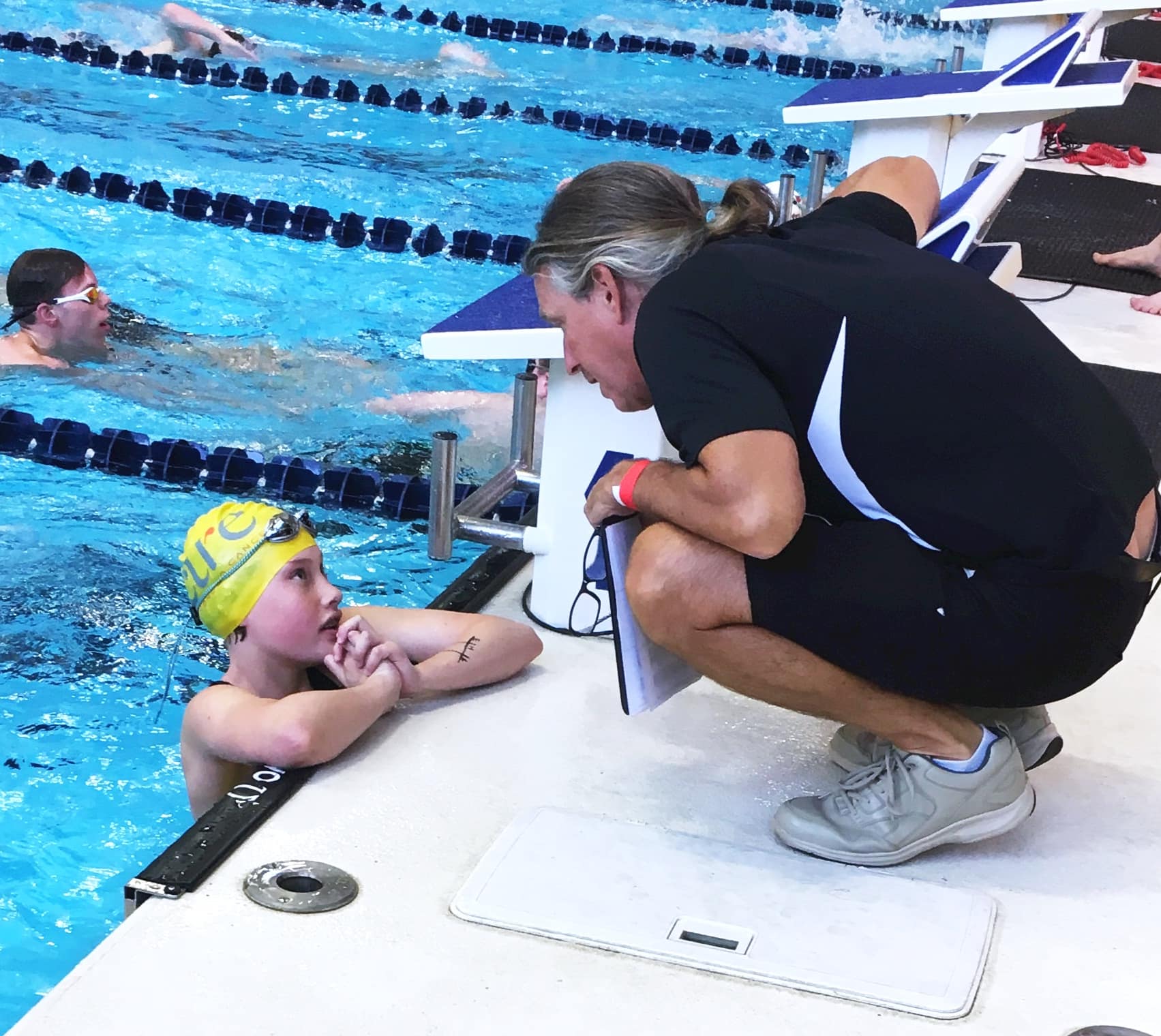
We all could use a little more Grace in our lives – and by Grace, I mean Grace Bunke. Grace is your typical eighth-grader: braces, curly hair, and a delightful smile. But Grace is exceptional in many ways and one you would spot immediately – her ankle is now her knee!

Don’t believe me?   It’s true.

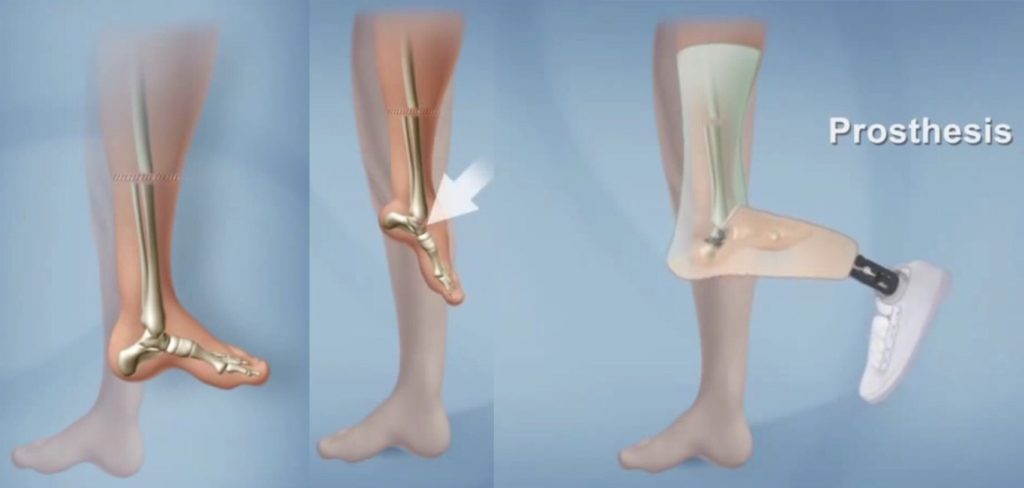
Grace was diagnosed with Osteosarcoma in August of 2014. With her treatment options limited, Grace and her family chose rotationplasty – an innovative surgery that removes the cancerous knee while the ankle is rotated and reattached to the limb. Since a typical amputation would limit her future flexibility, having a knee joint greatly increased the chance that Grace would be able to continue her athletic pursuits after treatment.

Grace is fast!

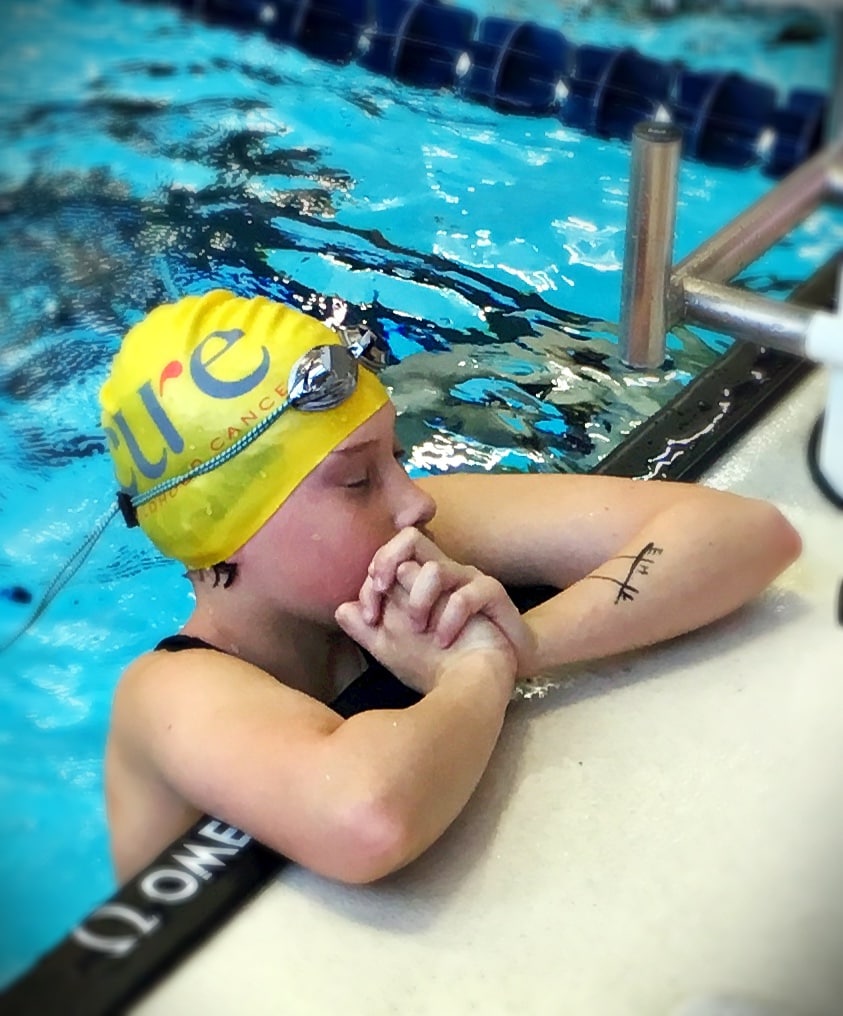
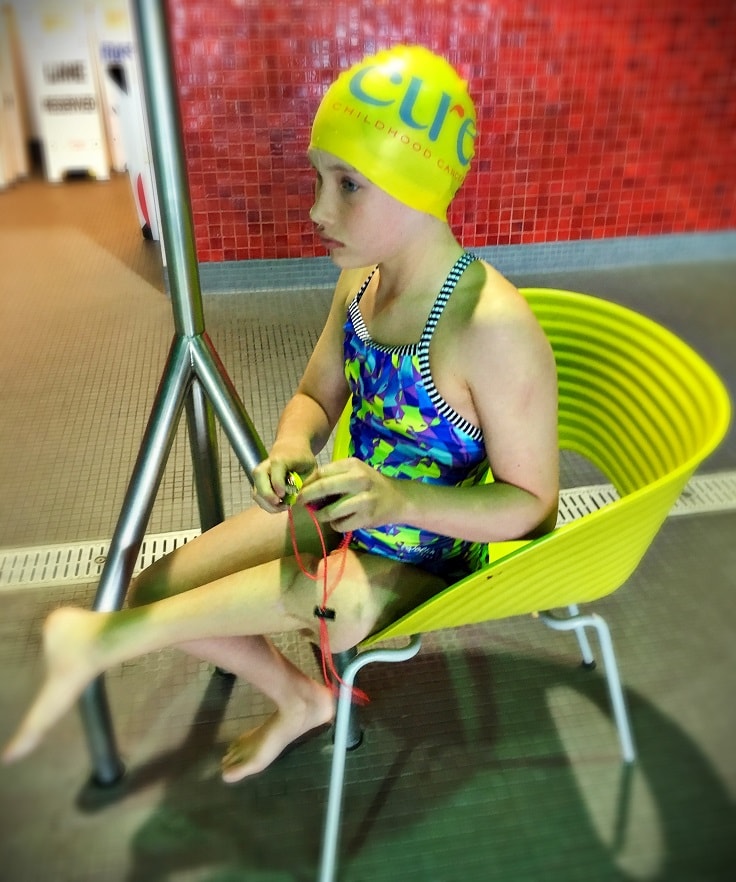
Before cancer, she ran track and cross-country. With a running prosthetic being built, those days on the track are soon to return. However, for now, she has a new love: swimming. Things can be difficult for a swimmer with half a leg. When she first got back in the pool she only used her full leg, but she gradually taught herself to use both and now there is no stopping her. She said it took a couple of months to really get the hang of it and go fast. Once she mastered the stroke she went on to swim competitively. In fact, she has her sights set on the Paralympics.

But October brought on a setback. After a routine scan, doctors found tumor growth in her lung that required immediate surgery. While the family prepared for the surgery, they also began to think about what that would mean to Grace’s swimming aspirations. Her mother, Vicki, wrote:

But more important than that, during the course of the weekend, Grace told me that she had designated the Can-Am Open Meet in Miami over the Thanksgiving break as her ‘come-back’ meet. When I gently implied that she may not be entirely ready for this meet, she replied with the following question:

Mom, don’t you believe in me?

Ugh – what a punch-in-the-gut-mom-moment.

Of course, I believe in you Grace, I replied.

And then added:

You have taught me more about believing than anyone I have ever met. And you have shown me that our best life is not our easiest life. Our greatest joy and satisfaction comes not from avoiding hard things but from joyfully embracing them.

The surgery is behind her now. The doctor removed a single lesion/nodule from Grace’s left lung and is confident that she obtained clear margins. And Grace? She’s back in the pool and pointing toward Miami at the end of November. You don’t have to talk to Grace very long to know that she’s driven. Once you meet her, it is easy to believe in Grace. In fact, I would say it would be impossible to spend a few minutes with her and be a doubter.

CURE believes in Grace and can’t wait to hear her race times later this month. We also believe that childhood cancers can be defeated in our lifetime. Join our team by contributing to life-saving research today. Your donation, however large or small, shows that you too believe.

Five Ways to Stay Healthy After Treatment

Five Ways to Stay Healthy After Childhood Cancer Treatment

Contributed by: Nancy Keene
(Updated January 2025)

The Importance of Follow-Up Care
for Childhood Cancer Survivors

National Cancer Survivors Day is an annual celebration of life held on the first Sunday in June. It inspires and supports survivors of cancer, including childhood cancer. There is much to celebrate––cure rates for many childhood cancers have dramatically increased. As a result, almost half a million children, teens, and adults living in the United States are survivors of childhood cancer.

The tough news is that most survivors of childhood cancer develop late effects months, years or decades after treatment. St. Jude Children’s Research Hospital found that 95% of long-term survivors of childhood cancer had at least one chronic health condition by age 45. The good news is that many of these late effects can be prevented or managed by getting excellent follow-up care and making healthy choices.

Five Ways Childhood Cancer Survivors Can Maintain Their Hard-Won Health


1. Get a Summary of Your Treatment

Every survivor needs a summary of his or her cancer treatment. The type and dose of chemotherapy drugs and the location and amount of radiation affect your risk of developing certain late effects. If you don’t have a summary, ask your oncologist or nurse practitioner to fill out a treatment summary form.
This health history will become an indispensable part of your medical records for the rest of your life. Keep one completed copy in a safe place and give a copy to each of your medical providers (e.g., internist, ophthalmologist, gynecologist).

2. Go to a Comprehensive Survivorship Clinic Every Year

Children, teens and adults who survived childhood cancer should be seen by experts at survivorship clinics. This is because most primary care providers have little or no training in the late effects that arise after treatment for childhood and adolescent cancers. For example, Hodgkin disease usually strikes teens and young adults. Many treatment plans for this illness include radiation to the chest and neck (called mantle radiation). About one-third of women who have this type of radiation develop breast cancer before age 50, and many more can no longer make enough thyroid hormone for good health. Both male and female survivors who had radiation to the chest also tend to develop heart disease in their 40s and 50s. Survivorship experts know about these late effects, but most primary care doctors don’t.

A recent study of 2,000 general internists who were given a vignette about a female survivor of Hodgkin disease found that:

  • 91% did not recommend yearly breast cancer surveillance
  • 85% did not recommend cardiac surveillance
  • 24% did not recommend yearly thyroid surveillance

The number of survivorship clinics has increased over the years, including clinics for adult survivors of childhood cancer.

3. Tell Your Primary Care Doctor About the Long-term Follow-up Guideline

If you go to a comprehensive survivorship clinic, the experts will base the screening tests you need on your treatment summary. They then will send a detailed report of their exam and screening results to your primary care doctor. But what should you do if you aren’t able to go to a survivorship clinic? The Children’s Oncology Group (the world’s largest organization devoted exclusively to childhood and adolescent cancer research) developed a set of clinical practice guidelines that provide recommendations for screening and management of late effects in survivors of childhood cancer. The guidelines,  developed by the 9,000 experts in the group, help physicians provide comprehensive follow-up care to survivors. If you are a survivor who doesn’t see an expert in late effects after childhood cancer, tell your healthcare provider about these guidelines so you can get the care you need and deserve.

4. Take Control of Your Health

Survivors have little or no control over their genetic make-up or the environment in which they live. However, making healthy choices about how to live the rest of their lives gives them quite a bit of control over their future. A sizable number of adult health problems are linked to lifestyle choices, so the following are ways you can stay healthy:

  • Don’t smoke (your insurance might cover programs to help you quit)
  • Eat a healthy diet (see a nutritionist if you need support)
  • Exercise and maintain a healthy weight (work out with a buddy to help stay on track)
  • Use sunscreen (especially on any areas that were irradiated)
  • Make sleep a priority
  • Drink alcohol in moderation, or not at all
  • Good health habits and regular medical care from experts will help protect your health and lessen the likelihood of late effects from your cancer treatment. You can learn more by reading Childhood Cancer Survivors: A Practical Guide to Your Future.
5. Do Things That Make You Happy

Happiness not only makes you feel good, but it helps you stay healthy and live longer. Different people need different ingredients for happiness. Some people join clubs to meet people with similar interests. Others like to hike, kayak or climb mountains. You might relax by reading a good book with a purring cat in your lap. Or contentment might come from helping others, working in a garden or spending time with close friends.

Seeking out activities that bring you happiness will not only make you feel better but will improve your health. As a cancer survivor, you have something other people don’t have––an awareness that life can change in an instant and that huge challenges can be overcome, one day at a time. Through your cancer journey, you probably lost friends, gained friends, and laughed harder and cried more than ever before. By taking a few actions to protect your health, you’ll have many more years to enjoy the life you fought so hard to save


*Nancy Keene is a childhood cancer advocate, speaker, writer and co- founder of a nonprofit (Childhood Cancer Guides) that publishes books to help families of children with cancer and survivors of childhood cancer. She has written/co-authored fifteen books––some chosen for Library Journal’s “Best Consumer Health Books of the Year” list. Her work has appeared in Coping Magazine, Reader’s Digest, Journal of the American Medical Association, Exceptional Parent and other publications. She served as chair of the patient advocacy committee of a consortium of 350 children’s hospitals and as the public member on an FDA committee that reviews medications given to children with cancer. Her mission is to help families of sick children and survivors of childhood cancer find their way through the medical maze—one step at a time.


Lendmark Climb to a Million

Lendmark Climb to a Million


Bobby Aiken, CEO of Lendmark Financial, is passionate about finding cures for childhood cancers. Over the last six years, he has known three different young men who were diagnosed with varying types of cancer.  All three survived, but their individual journeys caused Bobby to step back and rethink his view of challenges.

It was Chip Madren who had the most profound effect on Bobby. Chip’s father, Ken, and Bobby have had a friendship that’s spanned their lifetimes. The Friday before Chip was diagnosed with Stage IV Metastatic Anaplastic Medulloblastoma and given a very slim chance for survival, the three were fishing together.  A normal weekend.  But the news that broke on Monday was staggering. Bobby recalls, “In less than five days, we fished, laughed, ribbed one another, encountered a diagnosis of cancer, endured the first of many surgeries, and felt hearts breaking all around us. I’ll never forget the tears that filled the eyes of my family when I shared the news.  Life kind of seemed to stop in its tracks.”

As difficult as the early days were, it is the path since then that served as an inspiration to Bobby.  “Seeing people pull together to make a difference, watching Chip literally fight for his life and win, having Ken share stories of Lea’s (Chip’s mom) persistence and determination to keep everything aligned, the fight inside a mother for her child is incredible, it goes on and on.  Chip’s fight has made me a better person and has positively impacted many, many lives.”

Bobby is a stadium runner, and has spent the last few years thinking about Chip and kids like him who are facing the challenges of cancer while running.  He had an idea. What if he took his love of stadium running and turned it into a fundraiser, engaging his company’s employees, partners and vendors in the fight against childhood cancer.  The Climb to a Millon was born.

On Saturday, August 13, 2016 at Oconee County High School Stadium, Bobby’s vision became a reality as Lendmark Financial Services held its inaugural Climb to a Million.  His $150,000 goal was easily surpassed as employees and partners ran and walked 1 million steps. When all was said and done, Lendmark raised more than $225,000 for CURE.

Bobby says, “The Madren family is one of thousands that have to take on this fight every day.  It’s hard on every one of them and it’s a fight for every child. It takes every characteristic of strength, persistence, and faith; requiring reliance on one another and on those that surround them.  They did it, they continue to do it, and they set the example for others to follow.”


He’s Not Here

He’s Not Here

Moving. Leaving. Exchanging one place for another. Often it is done out of necessity, sometimes done by choice – a new job, new family, or an opportunity to prosper in another place. First comes the decision and then there is the packing. Endless boxes poured over with closets that seemed so small when you lived there, but never seem to have a back wall when you’re forced to clear them out. How many trips to Goodwill could there possibly be in a 2500 square foot house? The answer to that can be a staggering amount.

What do you take and what do you leave?

Most of us have moved at some point. It is a difficult process, to say the least. I have made the request of my family to never make me endure another move. When I go, I just want them to condemn the house and implode the walls around me. It would be easier for all of us that way.


Would you ever leave your child behind?


You laugh at that.

You are ready to close the browser and stop reading because the question seems preposterous. You say there is no possible way you would do that! You would never leave your child and on the face of it, I see your objection to my question. But I met a woman – a loving mother who was forced to do just that. She moved away from her son.

After a five year sickness that turned into a cancer diagnosis and ended in her son’s death at seven years-old, Stephanie’s life took a number of turns. She left Atlanta and moved further north where no one knew her situation, no one had heard of her son, and nobody spoke his name. His name. Creed. It’s not their fault, they couldn’t have known. Some have learned of her boy and will read about him and comment to her. That is a sweet effort that she always appreciates. But he’s not here. He lived two homes ago and often seems a lifetime away.

Everyone handles loss differently. For some, an escape is necessary. To move forward, they have to move away from the place of pain and that’s okay. There is no right way to grieve – no cookie cutter process or recipe to be followed that will mend a broken heart. Some hearts stay broken.

So how do you adapt? How does one go to a new place and leave their child behind?

“Our guest room is a shrine. I tell people they are welcome to stay but I warn them because I don’t want to freak them out when they see all of his stuff and his pictures on the wall,” she said. “And when the house is quiet and I need him, I go and lay down in his bed.”

Unfortunately, Mom’s like Stephanie aren’t alone. Cancer has caused far too many moms to make a choice to stay or move. She keeps Creed’s memory alive by telling his story and decorating his room. But more importantly, she is working with CURE to fund a cure to childhood cancer so that other moms don’t have to leave their babies behind. Join Stephanie today and contribute to The Creedlove Fund.

The Creedlove Fund provides support to patients undergoing treatment for childhood cancer and their families. Your gift, no matter how large or small will help a family in need.


A Moment with CURE’s Founder, Dr. Abdel Ragab

A Moment with CURE’s Founder,
Dr. Abdel Ragab


When Dr. Abdel Ragab started CURE Childhood Cancer in Atlanta 41 years ago, his mission was two-fold.  He wanted to raise money for pediatric cancer research, and he wanted cancer patients and their families to have a support group.  Today, with CURE funding millions of dollars in research and helping thousands of families throughout Georgia, Dr. Ragab says he is “stunned” at CURE’s growth and success.

“It’s like you put a seed in the ground and it’s now a huge tree,” said Dr. Ragab.  “I think that shows the dedication of all the people who work there.”

Dr. Ragab retired from pediatric oncology in 1993.  We talked with him recently about CURE, its humble beginnings and the advances in children’s cancer treatments today.

You say when you came to Atlanta and Emory back in 1975, there was a major need for an organization like CURE Childhood Cancer.

“It was critical that we started CURE, because universities are always lacking in funds.  Emory at that time was not what you see today.   We needed a new microscope to differentiate different types of leukemia, and they didn’t have the funds.”

“CURE started in 1975, and by 1976 we had $6,000.  That’s how we bought the microscope.  My office was at Grady Hospital at the time and of course it was difficult to go from one office to the next (at Emory).  So, the CURE group came up with funds to have a trailer put in at Emory.  In that trailer we had a research lab and we had our offices.”

Who were the people who helped raise money for CURE in those early days?

 “I would recruit them from our patients’ families.  I felt a little bad about that because they were going through a rough time with their kids, and they had to juggle their jobs as well.  The Atlanta Alumnae Chapter of the Tri Delta Sorority was also very instrumental in collecting funds.  They all did an excellent job.”

What are your thoughts on treatments for pediatric cancer today and the future of treatment?

“My belief is that all childhood cancers are of genetic origin…not to say they are inherited from the parents, although that is always a possibility.  But that it has to do with genes and oncogenes and tumor suppressor genes.  Destroying these oncogenes is the key.  Surgery, chemotherapy and radiation got us this far, but at great cost to the patient.  The future lies in manipulating the genetic code, which is proceeding, but very slowly.  One day we will look at the present treatment and say ‘How barbaric…’  I hope.”

What’s your reaction to CURE’s growth since you started it in 1975?

“Kristin Connor (CURE’s Executive Director) called and told me that CURE had collected over five million dollars this (fiscal) year.  CURE has done a fantastic job and I think there should be a great celebration for that.  I think more money should be spent locally, but you never know where the next breakthrough will come from.”