Category

Family & Patient Support

Pack Your Mental Health Survival Kit: Tools Every Teen Needs

As a teen, managing mental health while balancing school, friends, family, and relationships can feel like an impossible task. Add in the stress of a cancer diagnosis and things can feel like they are spiraling out of control quickly. With the right tools, though, we can strengthen our emotional well-being and bonds with others, even in times of high stress or critical need.

When we don’t feel well, get sick, or get injured, our doctors formulate and follow treatment plans to help us manage our pain and heal our bodies. Similarly, when we create and maintain a toolkit specifically designed to support our mental health, we can proactively protect our emotional needs and help safeguard against bigger issues from arising in the future.

Just like a first aid kit, there are lots of essential items that you’ll want to include to ensure you’re prepared for anything.

  • First and foremost, will be a short note detailing key mental health information:
    What are some of your go-to coping skills and strategies? (Examples may include deep breathing, muscle relaxation, thought stopping, yoga, dance, music, art, etc.)
  • Who are your primary support people? (Your list may include friends, family, counselors, spiritual advisors, etc.)
  • What emergency phone numbers may you want or need in moments of high mental or emotional stress? (i.e. Georgia Crisis & Access Line: 800-715-4225; Suicide and Crisis Lifeline: 988)

Once you’ve created your letter to yourself, it’s time to fill up the rest of your kit. As you select what items to add, it can be helpful to think about each of your senses and what appeals to them.

Sight: pictures of special places, people, and pets in your life; fun magazine clippings; a list of comfort books, videos, or TV shows/movies; favorite poems, quotes, or affirmations
Sound: favorite CDs or Vinyl; links to songs or artists that you enjoy; a seashell (to listen to the waves); a windchime
Touch: stress balls; fidgets; silly putty or slime; kinetic sand; fabrics or textures you enjoy; stuffed animals; weighted blanket
Smell: small bottle of perfume or cologne; essential oils; candles; wax melts; scented markers
Taste: chocolate (preferably dark chocolate, due to its proven mental health benefits); fruit snacks; bottled water; favorite candy or snacks; mints; chewing gum; favorite tea flavors or water enhancers

Once you have items supporting each of your senses, you will also want to include some mindfulness or grounding activities…anything that can help your brain focus on the present moment and not the tornado of thoughts, feelings, or fears swirling around in your head! Some options for this might be a small craft, a puzzle, coloring or doodling pages, sensory tubes, yoga pose cards, printed or audio-guided meditations, a finger labyrinth, or even a snow globe (to shake up and then watch as the snow settles back to the bottom).

Many of the items in your toolkit may already be around your home and simply need to be collected in one location, but others may take a bit more effort. The dollar store can be a great place to find affordable sensory items and activities, but if going to the store is too much to manage, then there are tons of resources and toolkit necessities available online.

https://www.strong4life.com/en/emotional-wellness/coping/healthy-coping-strategies-for-kids
https://www.nih.gov/health-information/emotional-wellness-toolkit
https://mentalhealthcenterkids.com/blogs/articles/coping-skills-for-teens

Finally, it is important to make your toolkit easily seen and accessible, by placing it in a readily available spot in your home and decorating it with positive statements, stickers, paint, or even a fun fabric cover. Start getting into the habit of looking through and using your toolkit on a regular basis, so that when you need it, your mind and body will already know just what to do!

If you or your sibling has been diagnosed with cancer, CURE can help through our Counseling Program. To learn more, visit curechildhoodcancer.org/family-support/counseling/ or contact Chelsea Key at [email protected].


Rachel Raven is a Licensed Clinical Social Worker focused on helping clients of all ages on their journey towards growth and happiness.

Marital Stability While Caregiving a Child with Cancer

By Alice D. Hoag, EdD

Caring for a child with cancer is one of the most challenging experiences any parent can face.  The emotional toll on caregivers is immense, often leading to feelings of burnout and strain on marital relationships.

It’s crucial for both partners to stay aligned in their approach to caregiving.  Even though they each have their own unique relationship with the child, they may have different outlooks on life and different emotional-regulation styles.  It’s vital for partners to stay connected as a couple, despite possibly having different love languages or expressions of their affection for each other.

Here are some tips:

  • Respect Differences

Acknowledge that each partner may cope differently with this stress and trauma.  One may be more hands-on with medical care, while the other provides emotional support.  One may need to take a leave of absence while the other increases their work responsibilities to make ends meet.  One may need greater physical/sexual intimacy during this season of distress. One of the most important things you can do is respect and value these differences and figure out a way to honor each person’s needs.

  • Avoid Blame

Cancer is no one’s fault.  Blaming oneself or one’s partner is a futile expression of anger, a waste of energy.  It won’t take the cancer away, and it won’t make it easier to navigate; it only creates division and exhaustion.

  • Unified Front

Let love and respect for each other be the strongest elements in your relationship with one another.  Present to your child that you are a unified team of love and safety for them, that both of you love your child in your own unique way, both of you are determined to keep your child safe, and both of you are working tirelessly toward your child’s healing.

  • Regular Check-Ins

While time together is scarce at best, especially during the early stages of diagnosis and treatment, making time to stay connected with each other is essential.  You are partners on this journey, not just co-workers.  Schedule regular check-ins to discuss your child’s care, your feelings, thoughts and concerns, and how to juggle all the other responsibilities. This helps ensure that both partners are informed and involved.

  • Communicate, communicate, communicate

In case you missed it with that last point, communicating with each other is an absolute necessity!  Communicating proactively and intentionally can be difficult when you’re both stressed, scared, and have no time. Give yourself and your partner permission to miss something important because you/they were multi-tasking and simply weren’t able to pay attention.  Ask the other to repeat what was just said or offer to repeat what you just said without irritation, gently and with compassion.  You are both most likely doing the very best you know how at this moment.

  • Set Boundaries

Establish boundaries to protect your relationship. For example, designate certain times as “couple time” where you focus on each other and not on caregiving duties or on the heaviness of cancer.

  • Delegate

Lean on your support network.  It is not uncommon for friends and family to express a desire to come alongside to help.  Since most have probably never experienced the devastation and overwhelm of caring for a child with cancer, this help is often so vague that it feels more like an obligation than a help.  (“Let me know how I can help.”)  I often hear from clients that they have no bandwidth to come up with ways people can help, so they end up not utilizing the help being offered.  Try to keep a list on your phone of small to large things people can help you with: making meals for those at home; running errands for things you or your partner may want at the hospital; taking care of your pet(s); babysitting your other children; play dates, or parties; providing lawn care, etc.

  • Seek Support and Professional Help

CURE Childhood Cancer is a rich resource of support for those on this journey; take advantage of all the services and support they offer. Many of my clients tell me they appreciate talking with a counselor rather than their friends/family because they “don’t want to burden them” with their painful journey all the time and would prefer keeping these relationships as distractions from the heaviness of cancer. Counselors are unbiased third parties who are trained to handle trauma and challenging emotions.

If you or your family needs support during your cancer journey, please contact Chelsea Key at [email protected].


Boosting Your Wellness

Parents and caregivers of children with cancer often feel the weight of the world on their shoulders. There are clinic days, hospital stays, dinners to be made, laundry piling up, and work deadlines to manage, not to mention the background fear, worry, and isolation you may feel.

May is Mental Health Awareness Month and it’s a great time to look at ways to boost your own mental well-being and resilience. Though a spa day would be nice, there are other subtler and smaller ways to boost your wellness.

  • As you sit and read this, notice your posture. Are your shoulders hunched and your torso curled forward? If so, breathe in through your nose and pull your shoulders down and away from your ears. Slowly breathe out as you lengthen your spine. Repeat a few times until you feel your body relaxing. Deep breathing is a powerful and effective way to help ground us in the moment, and it can be done at any time and place.
  • Try to catch a few “weak ties.” Weak ties is a term used to describe the people we interact with who are not friends or acquaintances, and research shows that weak ties are powerful mood boosters because they offer a sense of novelty with social engagement. Maybe there’s a friendly cashier at the hospital cafe, or a crossing guard at your child’s school who would benefit from seeing you smile and say thank you. Trying to find a few weak ties may brighten your (and their) day.
  • Give yourself permission to rest. Friends and family may want to show their support by visiting, but it’s more than okay to say that you really need some downtime and a nap instead.
  • Keep your eyes out for stray moments of joy and connection each day, like the nurse who can make your child laugh, or the warm hug from a friend who cares about you. These little moments add up, and they might be enough to buoy you through the day with a growing sense of wellness, even during the most challenging times.

In addition to these tips for boosting your own sense of wellness, here are some tools you can use with your child to help them manage feelings of anxiety. Having older kids draw or list out the things that make them feel anxious is often eye-opening for adults. Children with cancer are often more concerned about the logistics of medical procedures than the outcome of their diagnosis. Older kids and teens may be worried about procedures in addition to long-term outcomes and the effect cancer will have on their school life, friendships, and extracurricular activities. Doing the Inner Sirens activity, whether spoken out loud or drawn on paper, will help your child externalize their worries. (CLICK HERE to download an Inner Sirens sheet you can print.)

The Tips for Managing Medical Anxiety contains just a few of the tried and true methods for helping children get through difficult procedures. It’s always a good idea to prepare children for procedures using age-appropriate language, providing enough information to answer their questions without overwhelming them, and using resources like child life specialists and other professionals to help prepare your child. Young children will benefit from having devices and procedures shown to them and explained using stuffed animals, dolls, and sample medical equipment. (CLICK HERE to download Tips for Managing Medical Anxiety.)

Though childhood cancer is a painful journey, parents and caregivers are not alone. You can reach out to your doctor or CURE representative for help finding the support you need. If you would like to learn more about CURE’s Counseling Program, please CLICK HERE.


Written by Mary-Beth Archer from Art It Out.

Mary-Beth Archer is a licensed master social worker who provides play-based and expressive arts therapy at Art It Out. She is passionate about connecting with children and adolescents through developmentally appropriate play-based techniques. Her goal is to honor the individuality of each child and to help them develop the resilience they need to thrive. She has worked as an international children and families social worker and as a children’s trauma therapist. She has four children of her own and deeply understands the joys and challenges of parenting. Mary-Beth has additional training in Trauma-focused Cognitive Behavioral Therapy, Grief Counseling, and Sand Tray Expressive Arts

A Life of Strength, Love, and Courage

Weighing in at 9 pounds, 10 ounces, Chrisean was big from the start. He had so many rolls that his family called him the “marshmallow baby.” As a child, he enjoyed dressing up in a suit and tie, especially to go to church. At the age of 13, he stood an imposing six feet tall and weighed 250 pounds. When he stopped eating, his mother, Machelle, knew something was wrong.

“He was complaining about body aches and pain everywhere,” Machelle said. “We went to the doctor several times and came home with different pain medicines. But no one could tell us what was wrong.”

One day, Chrisean called Machelle from school because his chest hurt badly. She took him to the children’s hospital, where the doctor pulled down his eyelid and noticed his skin was nearly white. When he ordered a blood test, the staff found a new problem – Chrisean was terrified of needles. He was so big that the nurses had to get two men and a security officer to hold him down to draw blood. The blood test revealed that Chrisean had acute lymphoblastic leukemia.


“When the doctor told us, I was confident that he would be alright,” Machelle said. “He had a game plan and said it was very treatable.”

During his hospital stays, Chrisean questioned everything. He researched every chemo he was to be given and asked questions of doctors, nurses, and anyone who provided care. A little more than a year into his three-year treatment, Chrisean developed a cough that turned into a fever. His breathing got progressively worse until his medical team decided he needed to be on a respirator. Things descended rapidly from that point. With his immune system depleted because of chemotherapy, Chrisean’s body was unable to fight off a virus.

“Chrisean called everyone in the family and asked them to come to the hospital,” Machelle said. “I think he understood that he was at the end. He got to say goodbye and tell us all he loved us before he passed.”

Chrisean passed on August 25, 2020.

“We met CURE in the hospital with meals, and CURE supported our family at Christmas,” Machelle shared. “But I didn’t know CURE would still be here for us after Chrisean died.”

Machelle has attended CURE’s Hope and Healing bereavement retreats and regularly enjoys gatherings with other bereaved mothers, as well as CURE’s Quiet Heroes luncheon.

“I just want to thank you. Hope and Healing has been a saving grace for me,” she said. “A lot of times, I didn’t want to exist in this world without my baby, and most people don’t know what it is like to lose a piece of your heart. It was a breath of fresh air being around other people who know this pain. I still need help and support, but I can help moms who are new to grief.”

Focusing on What You Can Control

By Amanda Baskin, LMSW | Water’s Edge Counseling

Recently, our nation recognized the one-year anniversary of the coronavirus being a part of our daily lives. This anniversary marked many changes – changes in what we wear to protect ourselves, changes in how our stores and restaurants operate, changes in our healthcare. Some of these changes were difficult and painful, bringing about loss and separation – especially for children with cancer and their families, who have experienced fear, grief, and a rapid increase in anxiety and depression. And now, a year later, we have seen another change: apathy.

This apathy stems from hopelessness and helplessness that many are feeling from the ongoing effects of the pandemic. While mental health was discussed often at the beginning of quarantines and pandemic protocols, we are now seeing the prolonged impact of anxiety and depression. Those who have felt despair for months are now beginning to question the point in addressing the issues they face.

The apathy can show in many ways: not keeping up with personal hygiene, not reaching out to others when in need of help, or not making plans or goals for the future. It often manifests as a reluctance to try to better one’s situation, feeling that no positive outcomes will result despite their efforts. This feeling of hopelessness can morph into the simple question of, “Why try if nothing’s going to change?”

Families fighting cancer often feel a loss of control, and the pandemic has served to intensify that feeling. We cannot control the pandemic or how others react to it. Focusing on what is in your control can help to alleviate this feeling of hopelessness, and in turn, apathy. Ultimately, all that is in your control is what you think, feel, or do. It is in your control to get up each morning, put on clothes and wash your face. It is in your control to contact a friend or loved one. It is in your control to set boundaries that protect your time and energy. While the triggering of depression or anxiety may not be within your control, how you handle it is. Breaking down your day into small decisions makes things feel more manageable. Instead of focusing on how to complete a list of 20 responsibilities, focus on one step at a time. This reduces feeling overwhelmed or hopeless, because instead of looking at the 19 things you can’t do, you are focusing on the one you can.

One of the most important things within your control is asking for help. If you or a loved one feel overwhelmed with anxiety or depression, reach out for help. Talking with those around you about your experience can alleviate some of the stress that has built up. As we lean on one another, we also help to lift each other. During this past year, the mental health field has been working to make services more accessible. From telehealth appointments to safety protocols for in-office sessions, there are options available to best address your mental health needs in safe and comfortable settings. Choose today to focus on what is in your control to address your mental health.


Amanda Baskin is a Licensed Master Social Worker (LMSW) in the state of Georgia. She received her Bachelor of Science in Psychology at Georgia College and State University, and a Masters in Social Work, and a Marriage and Family Therapy Certificate from the University of Georgia. She works for Water’s Edge Counseling in Savannah, GA.

How to Keep a Routine with a Child in Treatment

By Mariah Dantzler, MS

It is important to understand that it may be inconvenient or nearly impossible to keep a routine while a family member is undergoing cancer treatment. But we know that rhythm and routine create feelings of safety and security. The following tips may help your efforts to create a routine within your family during this time.

When a child is first diagnosed with cancer, the parents’ focus is inevitably on getting their child the care and treatment they need. This focus continues through treatment and can last months or even years. Parents also do everything they can to ensure the rest of the family is cared for. However, due to doctor’s visits, hospital stays, and inevitable emergencies, things that had been normal in family life may fall to the wayside as the child in treatment needs to take priority. In order to acknowledge the shift in priorities while protecting the rhythm of the family, consider the following:


    • Identify 3-5 lifelines. Lifelines can be close friends, family, or members within your community who will rally around you and take on any task thrown their way. These are people who will help with transportation needs, laundry, lawn care, or whatever needs to be done.


    • Create a family mission statement, crest, or logo. You can often refer to this with your family in times of stress or hurt to bond together.


    • Try to keep siblings on their schedules as much as possible. For instance, keep them on their sports teams, in their favorite activities, and allow them to continue to have play dates. Rely on your lifelines to work out logistics.


    • Dedicate a time each month to have uninterrupted family fun time.


    • Keep bedtimes the same.


    • Make a chart of things that may change during this time, also noting what will still stay the same. This allows children to anticipate and prepare for inevitable change – but still feel confident they can rely on some things to remain the same.


    • Try to honor choices and individual preferences for children in the family in the areas they can control. Allowing them to choose such things as the clothes they wear, the snack they eat, or the television show they watch increases their feelings of having some healthy control of their lives.


    • Play with your children whenever you can. Younger children rarely discuss their problems openly, but they tend to show you how they are feeling through play and activity.


    • Encourage your kids to still have fun when they can. They need to know it is still okay to experience joy even during this challenging situation.


Coping with cancer is never an easy task, especially when a child is the one who is suffering. Just remember, your whole family is in this together, and all of your children need your attention more than anything else. Cleaning and laundry can wait! Love on them, spend time with them, and give all of them hugs just because.


Mariah Dantzler, MS is an Associate Professional Counselor who works with children and their families at the Summit Counseling Center, located in Johns Creek, Georgia.

A Witness to Joy

For many people, “December” is synonymous with joy. But for those fighting cancer during the holiday season, joy can be hard to come by. Thanks to our incredible community, CURE was able to add a measure of joy in many unique and heartwarming ways.

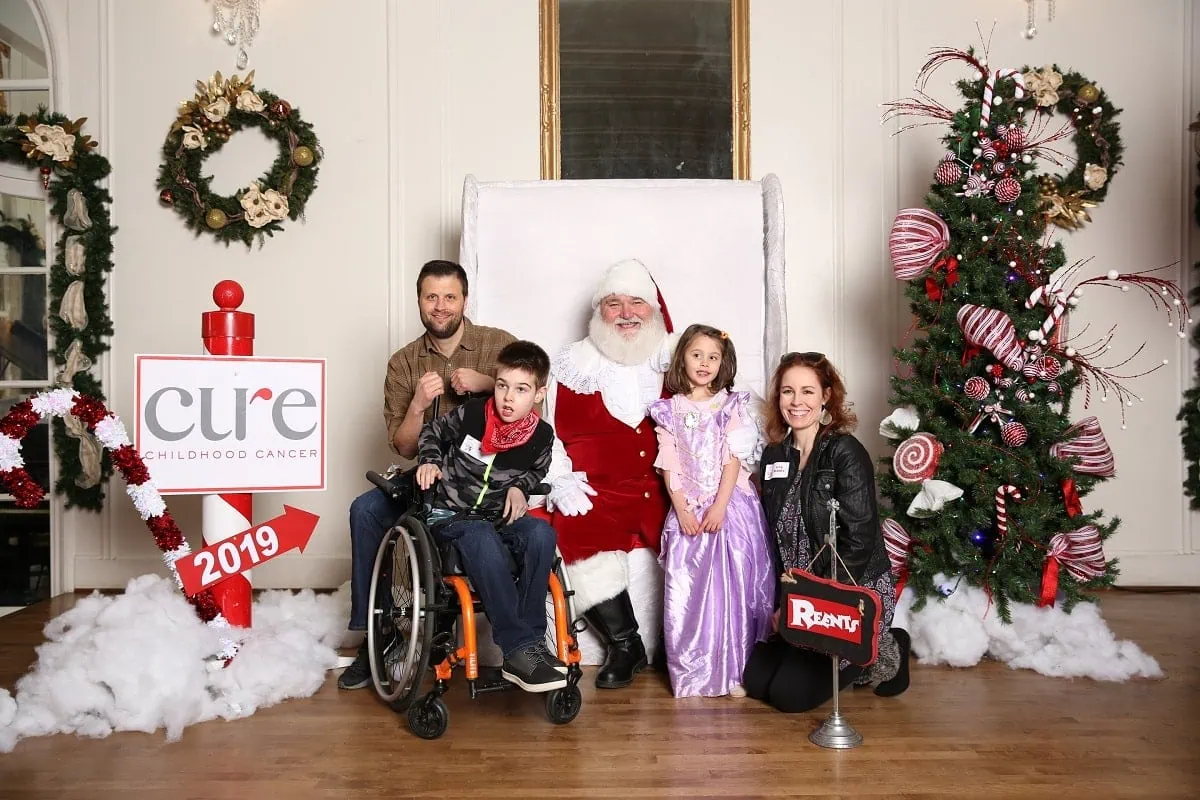
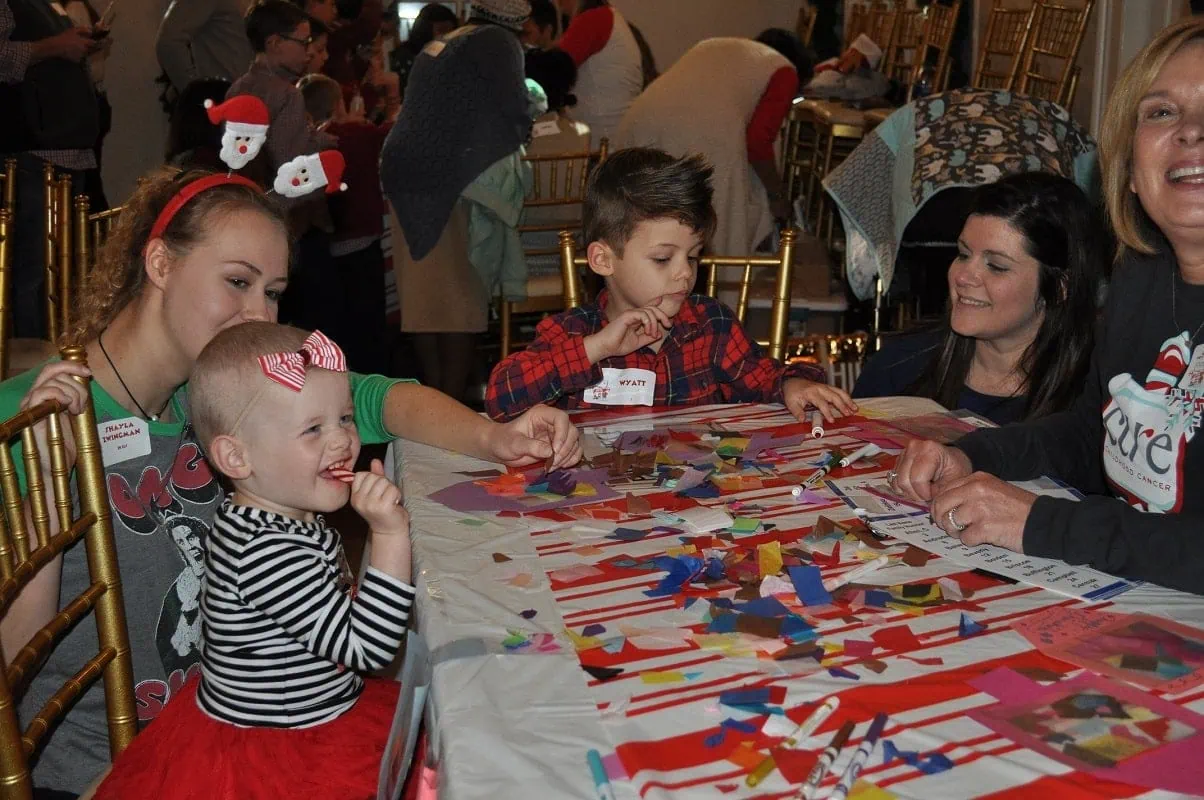
It started with holiday parties in early December. In Atlanta, more than 100 volunteers gathered at The Atlanta Event Center and welcomed 113 families to the festivities. There were games, gingerbread houses, crafts, holiday treats, and, of course, Santa stopped by to say hello. Between the patients, survivors, siblings, and parents, nearly 500 people were treated to a very special day.

“Thank you for putting a smile on my son’s face at the Holiday Party. He’s had a rough few months, but he really enjoyed today.”

Santa hopped on his trusty sleigh and hustled to Victory North in Savannah where he spent time with 37 South Georgia families. 176 guests enjoyed crafts, face-painting, treats, video games, and more. It was a joyful afternoon, as one volunteer remarked:

“I don’t think I have ever had as much fun and witnessed such joy as I did that afternoon. I loved that so many people were there, and it seemed that everyone could forget their worries for a few hours and just enjoy.”

Your generosity also allowed us to serve more than 1000 meals to patients and their families during December, including a very special traditional Christmas meal at both campuses of Children’s Healthcare of Atlanta. Just consider the boost that a plate full of turkey, mashed potatoes, and cranberry sauce gave families forced to be in the hospital instead of home for the holidays.

Donors supplied us with stockings, ornaments, pajamas, and blankets which we delivered, giving an extra nudge of encouragement.

Imagine being a parent dealing with the high cost of treatment during the holidays. With the unplanned expenses, there may not be enough to provide Christmas or Hanukkah gifts for your family. That’s where our donors really stepped up and became Holiday Angels. You took their wish lists and filled them all. In fact, there were so many gifts that we had trouble fitting the bounty in our office. Altogether, donors provided gifts for 104 families. Between our little cancer fighters and their siblings, 300 children experienced holiday joy when they opened their gifts.

The words of two families sum up the gratitude of all.

“Thank you to CURE Childhood Cancer! Today we went to their office after my child’s radiation appointment and I picked up gifts for my kids that had been gifted to us for Christmas. I am so excited to see their faces once they open up their Christmas gifts!”

“Thank you so much for your generosity.  You have helped make a difficult situation a little brighter for not only my child battling cancer, but our entire family. Our hearts are overwhelmed with gratitude! May your Christmas be filled with many blessings.” 

None of this would have been possible without you. Thank you for allowing us to spread holiday joy to children and families who desperately needed it.

Timothy’s Road to Health

Timothy is the kind of boy who would never let a little stomachache slow him down. A sports enthusiast, you could often find him with a ball in his hand – usually a baseball or football. But toward the end of 2017, a persistent stomach pain started to take its toll. As the pain’s severity increased, his mother, Sloan, began looking for answers.

“We began at our pediatrician and then progressed to a pediatric gastroenterologist,” Sloan recalled. “After about three months of trying things that didn’t help, the doctor ordered a sonogram.”

The sonogram revealed a tumor near his stomach and liver. Timothy was immediately prepped for a biopsy where the tumor was identified as neuroblastoma – a childhood cancer that develops from immature nerve cells found in several areas of the body. The diagnosis was a surprise because Timothy was eleven years old, and neuroblastoma most commonly affects children five or younger.

After the biopsy confirmed the results, Timothy had another surgery to add his port and started his first round of rigorous chemotherapy that was to last five months. While the treatment did wonders to shrink the tumor, it also ravaged his body at the same time.

“Timothy went from a healthy boy to a state of malnourishment,” Sloan said. “He was so sick that he got down to 48 pounds, and we had to have a g-tube placed to give him nutrition.”

The next phase of treatment was removal surgery. The chemo had worked to shrink the tumor, and during a seven-hour operation, doctors took out all they could. Because the tumor was wrapped around two major arteries, the surgeon was unable to remove it completely. Once he recovered, Timothy had a stem cell transplant followed by radiation, and then immunotherapy, which is a type of cancer treatment that boosts the body’s natural defenses to fight cancer.

The immunotherapy was particularly harsh on Timothy, and he spent weeks at a time in the pediatric intensive care unit. Through all of the difficult treatments, separation from friends and family, and time away from home, he never complained. Despite missing many days of school, he worked hard and was able to finish the sixth grade with all A’s!

Timothy has been declared No Evidence of Disease (or NED) for ten months. He isn’t quite finished with his treatment. In order to prevent a relapse, he is enrolled in a clinical trial and takes three pills twice daily. He will continue that regimen for another year and a half.

“All-in-all, Timothy is doing great,” said Sloan. “His weight is up to 80 pounds, and he’s looking forward to playing baseball again in the spring. We aren’t sure about football, but we’ll decide on that later. For now, we are just thrilled that he’s healthy again.”

Timothy’s family has expressed gratitude to CURE for helping them deal with the challenges of treatment. The hospital where he received the majority of his treatment was 80 miles from his home, and his stem cell transplant was 300 miles away. CURE was able to help ease the financial burdens of the travel through our family emergency fund – part of which helps with gas and other travel-related expenses.

“We want to make sure the high cost of transporting a child to treatment doesn’t take a toll on a family’s finances,” said Lisa Branch, CURE’s Director of Patient and Family Services.  “CURE is happy to be able to help families like Timothy’s in this way, because a long stretch of highway should never be a barrier to a child’s health.”

Helping Siblings Cope

Erin Nicolas, MS, LPC, CPCS, RPT-S

When a child is first diagnosed with cancer, the parents’ focus is inevitably on getting their child the care and treatment needed. This focus continues through treatment and can last months or even years. It is the natural and logical focus for parents, and even siblings would agree that parents must attend to the sick child. Parents also do everything they can to ensure the siblings are taken care of. However, with doctor’s visits, hospital stays, and inevitable emergencies, siblings are bound to get less attention, and their own struggles to cope with their brother or sister’s illness may go unnoticed. To help siblings cope, it is helpful for parents to know how children process major life events in the first place.

Children cope with major life events in bits and pieces. Within a 20-minute period, they may go from crying with sadness to laughing hysterically at something they saw on TV. Children rarely sit around and ruminate on difficult topics. This behavior can seem erratic and even inappropriate at times, but it is what children do. Children also process through play, not words. It can be difficult to sit down and have a long conversation with your five-year-old about her sister’s battle with cancer, but playing with her will may allow you to convey information better and result in some level of understanding. Play is a child’s most natural and comfortable language, so we need to let them use it to process major changes. Lastly, children tend to focus more on how they are going to be affected by their sibling’s diagnosis rather than how others are affected. This isn’t selfishness. It is developmentally appropriate.

So how can you tell if your child is struggling with her sibling’s illness? Remember that children don’t often tell us their problems. They show us. The first sign that your child is struggling is behavior change. Some children act out to get attention while others may withdraw. Those who withdraw often do so because they don’t want to be more of a burden to their parents. Losing focus and dropping grades at school are also a sign of struggle as well as changes in sleeping and eating habits.

Children are easily affected by their environment so when life gets disrupted by something as big as cancer, children are disrupted as well. They mimic what is going on around them. Another sign of struggle is when your attempts to comfort them never seem to be enough. Lastly, children will often isolate themselves from friends or lose interest in things they used to enjoy.

Helping your children becomes the next challenge. It can be exhausting trying to find time for everyone when you are juggling medical care, work, and the needs of the family. Here are a few tips to help siblings get through this difficult time:

  • Keep the rules the same. There will always be exceptions and special circumstances, but consistency should be a priority.
  • Keep to your routine as consistent as possible. Bed times, homework routines, etc. need to stay the same whenever possible. Consistency makes life feel more stable and secure.
  • Be honest and age appropriate with the information that you share. Younger children obviously need less detailed information, but they do need to know how side effects may affect their sibling. For example, they need to know that treatments will make their sibling more tired and less likely to feel like playing. Allow them to ask questions and don’t be afraid to say “I don’t know.” Remind them regularly that cancer is no one’s fault.
  • Set up regular family meetings to check in. Keep the conversation open.
  • Play with them when you can.
  • Utilize choices whenever possible. Children feel more in control of their world when they are able to make choices, even choices as simple as what snack to pack for school.
  • Keep your kids in as many of their regular activities as possible. They need to know that it’s okay to still have fun.

Coping with cancer is never an easy task, especially when a child is the one who is suffering. Just remember, your whole family is in this together and all of your children need your attention more than anything else. So you may need to put off cleaning and laundry – or ask others to help so you can spend time with siblings.  They will be grateful for your love and hugs.

Hope after Loss

The loss of a child is so unnatural in our society that many parents feel utterly alone in their grief. Since it is such a rare occurrence, most people have no idea how to help or even engage with a bereaved parent. As part of our commitment to support families devastated by childhood cancer, CURE brings these parents together every year at our Weekend of Hope and Healing. During this weekend, families celebrate the lives of their children while attending presentations and workshops designed to assist them in their grief process.

But it is so much more than that. Each year, we hear of new ways lives have been touched as parents of different races, religion, income levels, and ages come together and realize they are not alone. Last month, parents of 51 precious children gathered together to move forward in their grief. Here is just a taste of what they discovered.

Jonathan Day lost his son, Owen, in September of 2017 and found peace during the weekend.

“Whenever I am in a normal group of people, I can stop a conversation or destroy the mood by just talking honestly about my children,” he explained. “But here, I sat in a room with people who know exactly what I went through. I got to talk about Owen without making anyone feel uncomfortable. I found that soul-settling.”

Jonathan also took comfort in hearing that other men share many of the same feelings with which he has struggled.

“The rational side of me understands that cancer was out of my control,” he said. “But the emotional part of me still holds onto the feeling that I failed as a father. My principle job was to protect Owen and I didn’t. It was very powerful to hear that there are other men dealing with that same feeling. I didn’t feel isolated when I was in that room.”

Also in attendance was Trish McKay, who lost her nine year old daughter, Kate in April of last year. She found meeting the parents and learning about their children particularly meaningful.

“I got to make some new friends, share our stories, and learn all about their children,” she said. “And that was the best part, getting to know some of Kate’s new neighbors! I am always wondering about the new things she is doing now in heaven, and for once, I know a little bit of who she is probably hanging out with! They are really cool kids. Morgan, the sassy three-year-old who loves glitter and purple. Alyssa, the sweet fourteen-year-old who danced at her school. Anna-Charles, the six-year-old fashionista who sang Meghan Trainor songs for the nurses. Kian, the two-year-old who charmed the nurses and had an afro bigger than his head.”

We recognize that everyone grieves differently and there is nothing we could ever do to completely alleviate a parent’s grief. Grief is a process and we hope the weekend helps to move people forward wherever they are in that process. When we hear comments like those of Benji Hollis, we are assured that the weekend was meaningful.

“Our daughter, Anna Charles, passed away 4 months ago after a bout with Acute Myeloid Leukemia,” Benji relayed. “Our emotions were, and still are, too raw and we weren’t quite sure if we were ready to attend Hope and Healing. But attending was the best decision we’ve made. It was helpful to meet other parents who could relate to the pain and suffering that we are enduring. It didn’t make our pain go away, but it was comforting to know that we aren’t alone. We got the chance to really get to know some of the other parents, and we look forward to staying in touch with them, as well as seeing them next year. There was definitely a healing factor to the event that we didn’t have before we arrived. We showed up with hope and left with even more.”


If you’ve experienced loss, please note the common theme running through all three parents: community. There is something significant about sharing your pain with other people who understand. Whether online or in person, we urge you to seek out others whose similar experiences can help you move forward in your grief. There is hope after loss.