

Caroline’s life took a dramatic turn just after her first birthday. At ten months old, she began losing weight and battling what seemed to be a stubborn ear infection. What her parents initially thought was a routine childhood illness led to an MRI that revealed a more serious condition: a tumor attached to her optic nerve. The diagnosis was juvenile pilocytic astrocytoma (JPA), typically one of the more treatable brain tumors with an excellent survival rate due to its rare tendency to spread.
However, Caroline’s case would prove anything but typical. After surgeons successfully removed half of the tumor, follow-up MRIs revealed the unthinkable – the cancer had spread, with new spots appearing on her brain and at the base of her spine. This put Caroline in the rare 2-3% of JPA cases that metastasize, leaving her medical team searching for answers.
 Genetic sequencing through CURE’s Precision Medicine Program revealed crucial information: her tumor carried a gene fusion called KIAA1549: BRAF. This discovery proved to be both a challenge and an opportunity. While traditional treatments would likely be less effective because of this mutation, the discovery opened the door to targeted therapies called MEK inhibitors that could block the activity of proteins that cause tumor growth.
Caroline began immunotherapy and the genetic insight led her doctors to enroll her in a couple of clinical trials using these inhibitors. They finally began to see stable results with a better quality of life. After several years of hour-long infusions, followed by nausea, fatigue and hair thinning, Caroline was able to begin taking medication orally which mean fewer trips to the hospital.
In April 2023, Caroline had an emergency shunt placement to relieve the pressure caused by an excess of cerebral fluid. At that time, the surgeon took another tumor sample for additional gene sequencing. These results led them to a new clinical trial using a Type II pan-RAF kinase inhibitor that works by blocking a protein called Type II RAF kinase. After 6 months, the tumor mass showed a visible reduction, and two metastasized spots had nearly disappeared. Even more encouraging, her vision remained stable, a crucial concern given the tumor’s location near her optic nerve.
“We love to hear that the tumor is shrinking.” Said Caroline’s mother, Camille. “But we’ve been fighting so long that we’ve learned to appreciate and accept the word stable, too.”
When tumor growth was detected in July 2024, her doctors adjusted her treatment plan based on their understanding of her tumor’s genetic profile, leading to promising results.
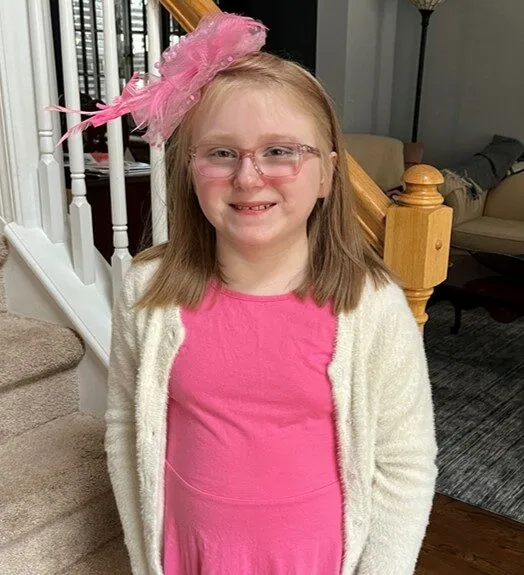
Today, Caroline continues to navigate her treatment journey with resilience. She is eleven years old and has found joy in creative pursuits. She excels at diamond art, a hobby that involves applying tiny resin diamonds onto a canvas to create designs. Despite her visual challenges, Caroline shows remarkable precision in placing the diamonds. She has also taken to writing and is 50 pages into a new book.
Caroline’s case is unique and complex. Thanks to precision medicine, her treatment path continues to evolve, guided by the genetic insights that have proven so valuable. Her story demonstrates the vital role genetic testing plays in modern cancer treatment, allowing doctors to create personalized treatment plans that target specific mutations and allow children like Caroline to thrive.


