
Category

Uncategorized

Wrestling with Emotions – Offloading Hurt

by Carleen Newsome, LPC, CPCS, ACS

Emotions are designed to inform us about what is happening in the world around us. However, in the midst of our grief, emotions can be so overwhelming that we try to run from them. Instead of recognizing our emotions, we adopt ways to cope which can prolong our suffering.
Hurt doesn’t go away simply because we don’t acknowledge it. In fact, if left unchecked, our emotions can fester, grow, and lead to behaviors that are not in line with who we want to be. These behaviors are ineffective and usually end up sabotaging many areas of our life, ruining relationships, and harming careers.

Resorting to ineffective strategies of dealing with emotions is called “offloading.” Below are six common strategies for offloading hurt:

Chandeliering: This strategy is when we try to stuff the hurt so far down that we believe we have escaped the pain. What actually ends up happening is that we have tender trigger points. When these trigger points are touched we react in an out of proportion way. A small thing like spilling our coffee may cause us to lose control and cry for hours.

Bouncing Hurt: Bouncing hurt is when emotions become unbearable and we place that hurt on someone or something else. For example, we may be having a hard day fighting off grief and instead of acknowledging it, we end up yelling at our spouse for not taking out the trash or grounding our kids for not finishing their dinner.

Numbing: Numbing is when we take the edge off pain with whatever we can find that will bring the quickest relief. It may be food, alcohol, drugs, TV, money, or caretaking. The problem is that we cannot selectively numb emotions. If we numb one, we numb them all. We may numb the grief, but we also numb the joy and happiness.

Stockpiling: Stockpiling begins like chandeliering where we pack the hurt away. We become so good at packing down the pain that we begin to amass more and more hurt. Without another outlet for our emotions, our body takes the brunt and may begin to develop many different health problems.

High-Centered: This strategy makes us feel stuck, powerless, and indecisive. We are afraid to allow emotion because we feel we may experience a floodgate of emotion and lose control. We are afraid that we may cry at work, in the grocery store, at a graduation, or around friends or family. We want to feel but we are afraid to allow emotions.

The Umbridge: We attempt to deal with hurt and grief by pretending. We become overly accommodating and people-pleasing. It feels and looks like a mask but is inconsistent with what we feel inside. It harms us and drives a wedge between us and others because it hides our true self within relationships.

Most employ these strategies at various times to survive and cope through difficult periods. But if you still find yourself using these strategies six months to a year after your loss or traumatic experience, it may be time to talk to a counselor so you can learn the steps to release you from added suffering.
 

But What Can I Do?

The question, “what can I do?” often plagues us when a friend or family member is hurting. We want to help, but the problem sometimes seems too overwhelming. Unable to figure out how to help, many well-meaning people often do nothing. But not Tom Jones. He figured out what he could do when cancer struck someone he cared about.

The Austin Taylor Challenge is an ultra-marathon benefiting CURE which was founded in memory of a little boy, Austin Taylor, who passed away in 2014 after a courageous battle with neuroblastoma. Tom participated in the 2017 Austin Taylor Challenge and reached out following the race.

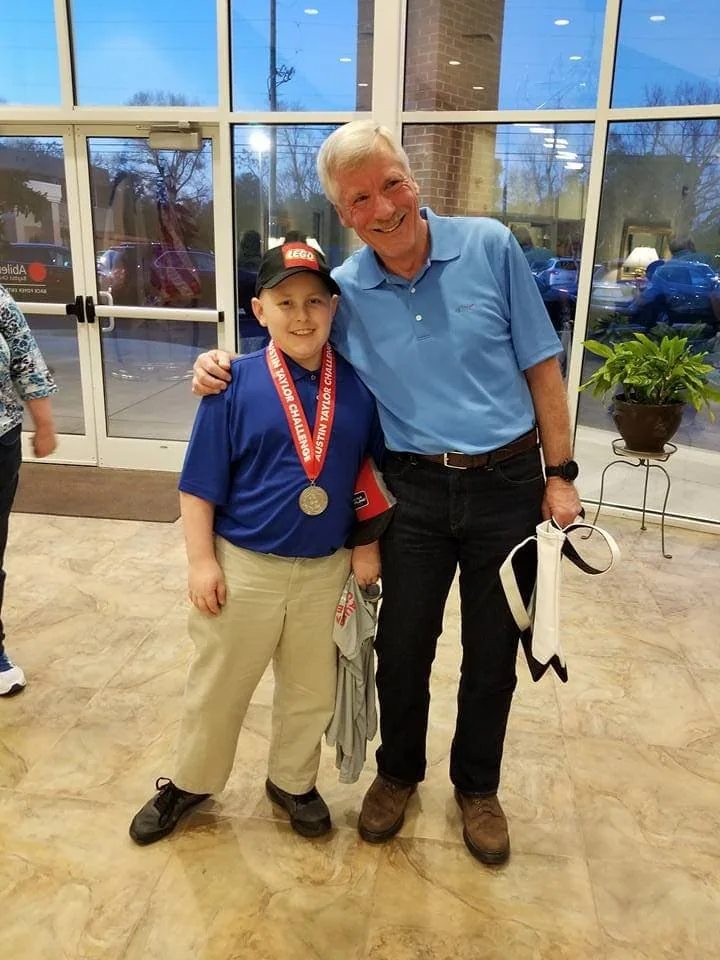
He wrote: I completed the 50k yesterday to honor a 12-year-old boy named Collin who had his foot amputated as a result of a rare form of cancer called epithelioid sarcoma. He has been fitted with a prosthetic and is doing well and is quite active. He has been through chemo and has lost all his hair but has a very positive attitude. I hope to meet him for the first time soon and present him with the finishers medal and hat and shirt from Austin’s race.

I was very moved by Austin’s story and understand the accomplishment of fellow-ultramarathoner, Joe Urban, in completing the Leadville 100 to honor Austin. I find it unbelievable that he could finish that race! I am sure Austin had inspired him so he was up to the impossible task! What an incredible young man! I know he made you very proud.

Moved by his note, we caught up with Tom and found him more unassuming and humble than would befit his accomplishments. It all started in 2009 when his pastor was facing liver cancer for the third time. They had run together in several local races, and Tom got the idea to run the Augusta half-marathon in honor of his pastor. He didn’t know how much it would mean until he gave the medal, race t-shirt, and a note of encouragement to his friend.

“His reaction was more than what we had expected,” Tom said.

From that experience, a ministry was born. Over time, Tom’s distances increased from half-marathons to full marathons, and then eventually he began running ultras. He runs about forty miles in a typical week unless he is building up to a long race. While he is training, he focuses on the beauty of nature and the one for whom he is running.

“Running to me is a celebration of life, and now a way to honor others,” explained Tom. “When I find someone who is hurting or struggling with a medical issue, my goal is to lift them up and also encourage their families during whatever journey they are on.”

Typically, Tom selects someone from the prayer list of his church in Evan, GA as his inspiration. But this year, a co-worker who knows Collin’s family asked if he would consider running for the boy. Tom was quick to agree. He had his own brush with childhood cancer. Tom and his wife, Karen, have six daughters. His now 18-year-old old daughter, Hannah, had her thyroid removed because it was cancerous.

“We have experienced the dreaded diagnosis of cancer in a child,” he relayed. “That makes me thankful for The Austin Taylor Challenge – a great race for a great cause. I’m also thankful for CURE Childhood Cancer and their efforts to rid so many young people of this horrible disease!”

Tom is an inspiration to all of us who struggle to put action to our compassion. He is making a huge difference in the lives of others by doing something he loves.

“If I can put a smile on someone’s face just because I ran a race for them, then it is totally worth the effort.”


Getting Jaden Back in the Game

Like many people in the south, Jaden and his entire family suffer from seasonal allergies. An early pollen season in 2017 aggravated his allergies, so his mother, Vicki, got Jaden some over the counter medication to help. The medication soothed Jaden’s cough for a period of time, but after a few days, it came back with a vengeance. Vicki took Jaden to his pediatrician’s after-hours clinic where the doctor gave him a breathing treatment because he had so little air movement in his left lung. When that didn’t help, the doctor sent him to the emergency room for an x-ray to check for pneumonia or a blood clot.

“Jaden was moved to the Pediatric Intensive Care Unit after his x-ray and CT scan,” Vicki recalled. “They wouldn’t tell me what was wrong, only that he was a very sick boy.”

After a long, frustrating wait, the doctor finally told Vicki that Jaden had leukemia.  The doctor would have to operate immediately to insert a chest tube into Jaden’s lung and take a biopsy to determine the specific type of leukemia.

This was not Jaden’s first run-in with cancer. A friend in pre-k named Evan had Acute Myeloid Leukemia and tragically, died after a year of treatment. Since that time, Jaden and his family have been fundraising and started Childhood Cancer Awareness Month Gold-Out games at the high school where Jaden’s brother played football. When he heard he had cancer, Jaden began to mentally process what that might mean.

“Dr. Johnson was great about it,” said Vicki. “He talked to Jaden on his level and explained that leukemias can be very different – that it wasn’t even apples and oranges, it was more like apples and watermelons. He really helped Jaden understand that his cancer and Evan’s were different. That calmed Jaden down.”

Jaden began chemo the same day as his surgery. The mass was so large that it had collapsed his lung. Fortunately, the chest tube gave him immediate relief and his breathing improved.

After a year of treatment, Jaden has two years left to go. His latest bone marrow scan revealed that he has less than .01% leukemia cells in his marrow. He will continue treatment until there is absolutely no trace of leukemia.

Right now, he is on the sidelines, but Jaden is looking forward to playing basketball and football again.

“Cancer has changed him,” Vicki said. “He has always been reserved, and the cancer drove him to be even quieter. He is finally starting to come back out of his shell, and he has decided that he wants to use his story to make a difference.”

Jaden and his family participated in CURE’s Kids Conquer Cancer One Day at a Time last year during National Childhood Cancer Awareness Month, sharing his story and raising money to fight back.  Jaden also helped with a Gold Out game at Richmond Hill High School and led the team onto the field.

“Cancer can hit anyone, so we feel that it is important for us to do our part to find a cure,” Vicki insisted. “Like I always say: I wasn’t a cancer mom until the day I was one.”


Participation in CURE’s Kids Conquer Cancer One Day at a Time is a great way to share your child’s cancer story with the community and join us in fighting childhood cancer. For more information about this wonderful program, please contact Lisa Branch at [email protected].


Life in the Key of Astonishing

Life in the Key of Astonishing

It is quite an honor for a student to be accepted into the Governor’s Honors Program (or GHP) in Georgia. The GHP is a four-week, summer educational program designed for intellectually gifted and artistically talented high school students. Rising juniors and seniors are nominated by their teachers and are screened through a rigorous round of essays, auditions, and interviews. The overall acceptance rate of the program is around 3%.

Those who know Loren Bass-Sanford and have heard her play probably were not surprised when they learned of her acceptance into the GHP as a jazz pianist. What might surprise them are the obstacles she overcame to get to there.

A persistent cough and what seemed to be regular cold symptoms escalated until she stopped walking and talking. Just before her third birthday, she became so weak that she could only lay in bed staring blankly at the ceiling. Her mother’s intuition drove them to the hospital where Loren needed a blood transfusion to make it through the night and was soon diagnosed with leukemia.

“I have some vivid memories of life during treatment,” Loren said. “Once when I was in pre-k, one of my little friends asked me about the bump in my chest. I tried to explain about the port, but I’m sure she didn’t understand.”

The standard treatment for pediatric leukemia lasts between two and three years for most children. Loren was cancer-free and considered a survivor at five. When she was ten, a long, six-hour appointment marked the end of her five-year remission period. She will continue to go to survivor’s visits every year until she reaches the age of 21.

One of the chemotherapies administered to Loren during her treatment was vincristine, which can cause numbness, tingling, and fine motor skill issues in the hands and feet. Sometimes, these side effects occur during treatment and sometimes they appear long treatment is complete. When Loren began experiencing such issues in her hands, she turned to the piano as a form of therapy. Her aptitude quickly revealed itself and the level at which she can now play is truly astonishing when the side effects she deals with are taken into consideration!

Loren is often complimented on her talent. Humbly she replied, “I just love playing piano. It was an honor to be at GHP; I learned so much.”

This rising senior at Lovett School doesn’t take her health for granted. She is on the Student Service Board and has joined the fight against childhood cancer. Last year, she led an effort for the Leukemia & Lymphoma Society’s Students of the Year project. This year, she is leading Lovett’s Gold Out game during September’s Childhood Cancer Awareness Month.

“Lovett has a long history of partnering with CURE in fight against childhood cancer and it is incredibly special to have a childhood cancer survivor lead the charge this year,” said CURE’s Executive Director, Kristin Connor.


In addition to the Lovett School, many high schools are holding Gold Out games in September.  If you’d like to host a gold out game at your school, visit www.gogold4CURE.com where you can download everything you need to plan your event.  If you have any questions, please contact Mark Myers at [email protected].

The Taste of Success

The Taste of Success

When CURE’s good friend and long-time partner, the St. Regis Atlanta, shared with us a concept for a new culinary event in Atlanta called Out of the Kitchen, we were immediately excited. The enthusiasm of General Manager, Guntram Merl, who had started Out of the Kitchen charity events at other properties he has managed, was contagious.

“Honestly, the over-the-top, elaborate idea was unlike anything offered in Atlanta,” recalled Lauren Sims, CURE’s Director of Development. “I thought Guntram had an incredible concept, and we were thrilled to be chosen as the charity partner. During the planning of the event ,we watched in amazement as the best chefs in the city jumped right in.”

The inaugural event took place on November 16, 2017. The beautiful St. Regis ballroom was transformed into sixteen intimate tables with seats surrounding a food preparation area. Each table had its own chef who created a unique menu just for the event. During the night, these chefs prepared food in front of the guests, talked and laughed with them, explained techniques, and shared culinary secrets. To walk the floor was to stroll from country to country as the smells of cuisine from Italy, France, Greece, Thailand, and many others wafted in the aisles.

And if the smells and tastes weren’t enough, after the dinner a spontaneous auction erupted. Local foodie legend, Steak Shapiro served as the master of ceremonies as the chefs offered extraordinary, personal culinary experiences for the top bidders. The room roared with laughter when Chef Kevin Rathbun took over the host duties and handled the microphone nearly as well as he handles a knife. Every guest raved about the evening, and CURE was thrilled to be a part of it. All told, the night raised $225,000 and left our hearts as full as our stomachs.

“The incredible generosity of time and passion from our Atlanta Chef’s community makes an event like Out of the Kitchen possible,” said Guntram. “Partner this with the truly amazing organization that CURE is… what a ‘recipe’ for a truly remarkable evening. The St Regis Atlanta is so grateful for being able to bring this to our community and we hope that this will become the marque culinary event for years to come.”

Thank you to the St. Regis Atlanta, Steak Shapiro, and all of the incredible chefs who donated their time and talent to benefit our mission to find a cure for childhood cancer. Out of the Kitchen 2018 will take place November 15. After the success of the inaugural event, we know it won’t take four weeks to sell out this time.


A Survivor’s To-Do List

A Childhood Cancer Survivor’s To-Do List


It is important that childhood cancer survivors focus on staying healthy after cancer. Here are some helpful tips to consider:

  1. Make your appointment to visit a cancer survivor clinic. Survivor visits begin when you are two years past the completion of cancer treatments. If you have reached this milestone, talk to your oncologist about a referral to your hospital’s survivor program. In the cancer survivor clinic, you will be educated about your risk for any late effects which might be side effects from your cancer treatment. You will also be checked for those side effects through labs or screening tests. You may see an oncologist, an endocrinologist, a pediatric psychologist, and a social worker. The number of providers you see is based on your health needs. If you already attend survivor clinic, be sure to make your appointment for 2018.
  2.  Find and review your survivor healthcare plan. If you have already been to survivor clinic, review the survivor healthcare plan you received in clinic. The survivor healthcare plan will outline the cancer treatments you received, the late affects you are at risk to develop, and how the survivor team plans to check you for any late effects. If you have any questions about what you find in your survivor healthcare plan, jot them down and bring them to clinic with you. If you have been treated in Atlanta and can’t find your survivor healthcare plan, check Cancer Survivor Link online! When you register for Survivor Link at cancersurvivorlink.org, each year when you come to the survivor clinic, the team will upload the newest version of your survivor healthcare plan to your electronic record.
  3. Learn a new self-management health skill. If you are an adolescent or young adult, work on a new survivor skill. A parent of a younger survivor could help him or her choose and develop a skill. This could be the survivor calling to make the clinic appointment, making the co-pay at the time of the appointment, or downloading the survivor healthcare plan from SurvivorLink. You may choose to know the names and doses of your medications or call in the refills this year. There are many skills that need to be learned, but if you learn them one at a time you will have them all down in no time.
  4. Be sure to keep seeing your primary care provider for normal child and adolescent medical care and visit your dentist twice a year. Sometimes there are so many specialty doctor’s visits, it is hard to fit in the “normal” visits, but they are important too. You want to keep your primary care physician up-to-date on your health so he or she can take care of your routine medical needs. Also, don’t forget to get your teeth cleaned and eyes checked.

There are several skills a young survivor needs to learn to maintain health. By working to master one or more of these skills in the coming year, you will be setting yourself on the right path to a healthy life after cancer.


Driving as Long as it Takes

Driving as Long as it Takes


“Nothing’s been normal with Evan,” his father, Kraig, said. “Not in his whole life.”

Evan’s whole life consists of almost three years, and his abnormal childhood began in the womb. Kraig and his wife, Brittany, live in Leary, a tiny town in the southwest corner of Georgia. Doctors discovered a heart defect during a routine ultrasound while Brittany was pregnant. Knowing he would need open-heart surgery at birth, doctors induced labor as early as was safe.

Kraig said it was very stressful knowing their baby was going to need open-heart surgery as soon as he was born. His mind drifted toward the worst possible outcomes, and he worried about both his son and his wife. The surgery was a success, but complications forced more heart procedures over the next few months. Doctors also found a problem called hydronephrosis that resulted in an oversized kidney, possibly due to blockage. That became the next issue facing Evan’s medical team.

To fight these problems, the family had to make many trips to Atlanta where specialists were prepared to help. Depending on the traffic, that trip took roughly four hours each way. And the surgeries weren’t the only thing that forced them on the road. Because of his frail condition, normal childhood illnesses were harder on Evan than the average child.

Still, they rode out the surgeries and illness through his first year of life and felt like they were on the road to recovery. At sixteen months old, Evan was cleared by cardiologists and shortly thereafter had a scan to make sure the hydronephrosis was gone. The scan revealed a mass on his kidney. After surgery to remove it, Evan’s parents were introduced to a new team of doctors: pediatric oncologists. The tumor was neuroblastoma – a childhood cancer that can form anywhere in the nervous system.

The successful tumor removal put Evan into remission, but he quickly relapsed. Since then, he has had multiple rounds of chemotherapy, two bone marrow transplants, and antibody treatment. All of this treatment occurred in Atlanta. In fact, Kraig estimates the family has driven that well-worn path over one hundred times in the last three years. How has Evan taken it?

“Right now, you wouldn’t know he has health problems if you didn’t see the scars,” Kraig shared. “He loves to be outside and sit in my lap for a ride around the fields.”

Of course, it would be hard to miss his scars. By Kraig’s count, Evan has around ten of them on his tiny body: two from open-heart surgeries, two from the tumor removal, and six from chest tubes he has had over the years. He also has a gastric feeding tube that has been crucial for nourishment.

Evan is currently receiving antibody treatment, a type of immunotherapy where agents designed to attack cancer cells are introduced into the body. This targeted therapy seeks to kill the cancer without damaging healthy cells. CURE has invested heavily in such innovative research with the hopes of speeding it to the bedside of children who need it – children like Evan.

During Evan’s battles, Kraig has felt overwhelming support from their community and his employer, the Coastal Plywood Company. But he is quick to point out the most important member of his team.

“If it wasn’t for Brittany, I don’t know where we would be,” he said. “She keeps up with all of Evan’s appointments and medications and makes sure he gets everything he needs. We’d be lost without her.”

Doctor’s estimate Evan has six months left in treatment before he can put cancer in the rear-view mirror. Kraig said he will keep driving as long as it takes to give Evan a normal life.

“I don’t want much,” he explained. “I just want us to be a family again.”


Robert’s Ready for Lauren’s Run, Are You?

April in Atlanta means short sleeves, bursts of azaleas, a robin’s song, and pollen… lots and lots of pollen. April also means it is time for Lauren’s Run and CURE Annual Picnic. Nestled at the very end of the month, Lauren’s Run has become a can’t-miss family event for our community. It also brings out the competitive fire in some.

One of those competitors is Robert. This year’s Lauren’s Run will be Robert’s fifth. While he might seem unlikely to win the race, his team is the reigning champion in one very important category and he doesn’t intend to relinquish that honor without a fight.

Robert’s run with cancer started in 2010, when he was only six years old. His parents noticed that he was more tired than usual and when dark circles appeared under his eyes, they immediately took him to the doctor. Soon they were on their way to Children’s Healthcare of Atlanta where they learned that Robert had leukemia. His treatment lasted three years and just as they finished, a spinal tap indicated that he had relapsed. Since that time, he hasn’t been able to outrun cancer. Whenever he beats it, the cancer seems to catch right back up to him. His treatment has taken him across the country a few times in a search for long-term success.

Throughout this whole journey of chemotherapy, spinal tabs, side effects, hospital stays, and family separation, Robert has shown amazing strength. He’s never complained and has dealt with every situation better than most adults would. His smile is big and his laughter infectious.

“Robert has taught us what is important in life and what really matters,” said his mother, Kasie. “This year Robert turned 13 and has officially been battling cancer longer than he has not.”

Last year, Robert and his Team Robert the Great won the coveted title of Top Fundraising Team with nearly $10,000. Just like in the picture, he was at the very center of the competition.

“He really wanted to win,” Kasie said with a laugh. “When other teams got close to our total, he would share a video of himself dancing and ask for more on Facebook. And people responded.”

Kasie doesn’t want Robert to know, but she shared her fundraising secrets with us.

“The key is to express the need. And to do that, you have to ask – face to face and by email, as well as on Facebook! People just don’t know how little is spent on childhood cancer research. But when you tell them, they almost always want to help.” she said. “CURE Childhood Cancer has been a big part of our lives since Robert’s first day at the hospital and we’re proud that the money Robert’s team raises for Lauren’s Run goes to fight cancers that affect kids.”

Robert’s team is already in first place for this year with over $5500 raised and he is working on his dance moves in case he falls behind.

Whether you want to join Robert or compete with him, we are all on the same team when it comes to fighting childhood cancer. By participating in Lauren’s Run, you’re taking a small step that can have a massive impact in the fight against childhood cancer. Won’t you join us?

Join Us at Lauren’s Run


Coffee Served with a Purpose

There’s a new coffee shop in town – but it isn’t like the ones you know. Of course it will have strong coffee, pastries, and plenty of hand-crafted, decadent beverages more worthy of a desert plate than a ceramic mug. But the concept of this coffeehouse centers more around community than caffeine. It’s an idea that germinated in the owner’s mind during a yoga session and it is soon to spring to life.

Jalynn Barr is a young lady passionate about her family, her community, her work, and causes that help other people. The cause that motivates her the most is childhood cancer. She serves on the Young Professional Leadership Council for CURE Childhood Cancer and has been a driving force in bringing others into the fight for children with cancer.

“As a mother, I can’t imagine having one of my daughters in treatment,” Jalynn explained. “When I found out how little money goes to childhood cancer research, I knew I had to get involved.”

Jalynn has been in the foodservice business her entire career and loves dealing with people. About a year ago, she started feeling an itch to get out on her own. While in a 40-day yoga challenge, a question kept coming to mind, “Is there a way I can make a career out of something I love that also benefits this group that I’m so passionate about?”

It was then that the idea for Community Cup was born. The location she chose is just off the square in downtown Cumming, where there is plenty of both driving and foot traffic. The menu will be strong on coffee, but will also serve fun things for children such as drinks with edible glitter and other items designed to create a family atmosphere.

The goal is to use her talents and passions to be a positive force in the community. By buying the baked goods from a local bakery and the coffee from a nearby roaster, Community Cup will pour first into its neighbors. But it will also weave itself into the fabric of the city by working with local schools, non-profits, and civic groups to help them raise funds for their efforts. And a portion of the shop’s daily proceeds will be given back to CURE to benefit those children with cancer that Jalynn loves so much.

“I really think we have a chance to make a huge difference,” she said excitedly. “First in Cumming, but through our partnership with CURE, all over.”

Permitted to dream, Jalynn wouldn’t turn down the chance to have a Community Cup on every street corner in the country. But her true goals are much more grounded: operate a successful business, spend quality time with her family, be happy in her work, and make a positive impact on her community. If she can stay centered on those things, she’ll count it worthwhile.

Community Cup hopes to serve its first customers in late March.

There is another event in late March that Jalynn is excited about. The YPLC is hosting the 2nd annual Spring Fever event and you’re invited. On March 23 at the Stave Room at American Spirit Works, you can enjoy live music from local favorite Crane, delicious food, and hand-crafted cocktails for just $75 with the proceeds benefiting CURE. Last year sold out early, so get your tickets today!


“Something that Shouldn’t be There”

In the summer of 2015, three-year-old Ava began complaining of lower back pain. After being sent home from daycare on several occasions and multiple inconclusive trips to the pediatrician, Ava’s mother, Julie knew that something had to be wrong. One Sunday after Ava began crying and complaining about her back, Julie took her to the emergency room. An ultrasound immediately revealed what the technician said was, “something that shouldn’t be there.”

That something turned out to be a tumor the size of a man’s fist on Ava’s right adrenal gland. After waiting anxiously for several days for biopsy results, the doctor came back with a diagnosis of stage three, high-risk neuroblastoma.

“I fell apart,” Julie recalls. “The idea of cancer never entered my mind. I always thought of cancer as something that old people get, not kids.”

Ava’s treatment plan was overwhelming: chemotherapy to shrink the tumor followed by surgery to remove the remainder of the tumor along with the adrenal gland to which it was attached. This was to be followed by more chemotherapy, two stem cell transplants, radiation, and finally, immunotherapy.

“We were so thankful that the tumor responded to the chemo and the doctors were able to remove it before it invaded any of Ava’s other organs,” Julie said.

Ava lost her hair and became thin but never really minded being bald. Her mother says that Ava took everything in stride and always had a good attitude. She remembers the stem cell transplants as the worst part of the treatment.

“Ava was so sick each time and the room would start to feel like a prison,” she said.

Ava completed her treatment in October 2016. Now five years old, she will start kindergarten in the fall. She gets scans regularly and is enrolled in a clinical trial designed to prevent relapse.

“Ava will never truly be free from cancer,” Julie says. “The treatment they gave her to kill the neuroblastoma has affected her teeth and could have affected her body in many other ways that we won’t know about until she gets older.”

But for now, Ava gets to be a kid again and return to her favorite pursuits: singing, dancing, and all things creative. She plans on becoming a ballerina when she grows up. Through this experience, her family has learned just how precious life is.

“We are so fortunate,” Julie says. “We saw other parents lose their children to this disease. We have always enjoyed spending time together as a family, but cancer showed us how fragile life is and now we make each moment count because of it.”